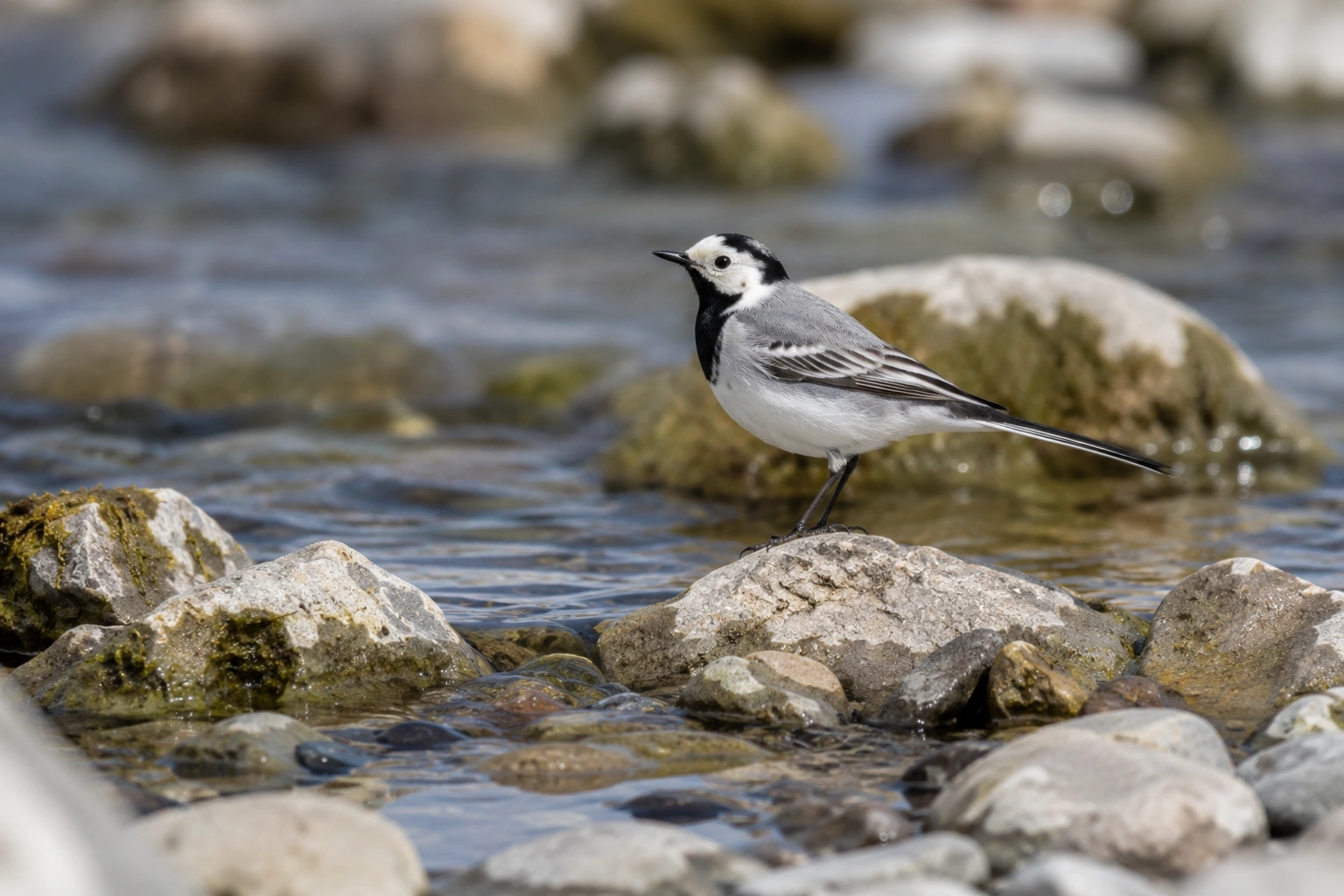
White Wagtails got their name from their constant tail-pumping. A rapid up-and-down motion that's a hallmark of the family.
They're famously tied to flowing water, hunting insects on stream banks and shorelines.
Subspecies vary dramatically in plumage; the British 'Pied Wagtail' is much darker than continental White Wagtails.
Wagtails don't use traditional nest boxes. They nest in cavities and on ledges. An open shelf in a garage or under a covered porch can occasionally host them.
Mount the open shelf 2–4 m up under a covered eave or inside an open shed or garage.
A garden pond, stream, or even a regularly-watered lawn attracts them.
Insects only, they walk and run after them on lawns and pavement. A no-pesticide yard is essential.
They want OPEN ground for hunting; minimal landscaping near the nest.
Don't disturb the nest in summer; pairs raise 2–3 broods and reuse the same site.
A widespread Eurasian wagtail with multiple subspecies, common across Europe, much of Asia, and parts of North Africa.
Year-round resident throughout.
Common breeder; northern populations migrate south for winter.
Resident or migratory across most of the continent.
Northern populations winter around the Mediterranean.
Open country near water, riverbanks, shorelines, lawns, parking lots, sports fields. They love open short grass adjacent to water.
No entrance hole, no front wall, just a sheltered ledge. Includes drainage and the integrated mounting tab.
Shop the lineupNorthern populations are migratory; southern populations are largely resident.