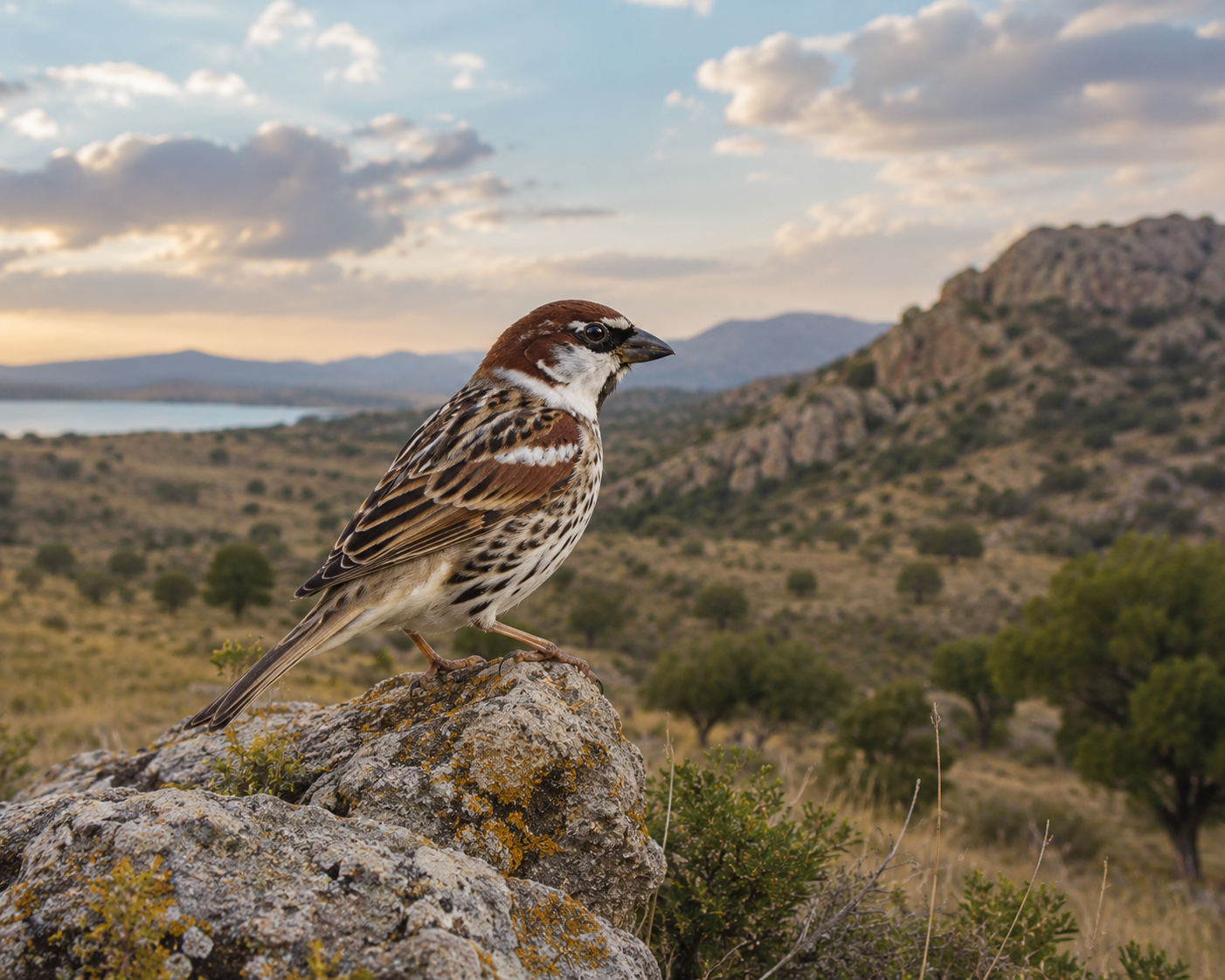
Spanish Sparrow
Back to Birdhouse Guide
Cavity Nester ⌀ 1.25" Small

Spanish Sparrow

Passer hispaniolensis

The most boldly-marked European sparrow - males have a chestnut crown, white cheeks, and a heavily streaked black-and-cream underparts that no other sparrow approaches. A colonial Mediterranean and North African farmland bird that builds huge communal stick nests in tree canopies, and the parent species (with House Sparrow) of the stabilised hybrid Italian Sparrow.

IUCN Red List
Least Concern

Widespread and abundant; no known immediate threats to the population.

Floor
5" × 5"
Interior height
8"
Entrance hole
⌀ 1.25"
Mount height
6–20 ft
Breeds
Apr–Jul
Broods / yr
2
Cool Facts

Things you didn't know about the Spanish Sparrow

01

Males are the most heavily marked sparrows in Europe. Spring-plumage males have a full rich-chestnut crown (not just the nape stripe of a House Sparrow), bright white cheeks, and a bold black bib that bleeds down into heavy black streaking on the flanks and breast - unmistakable side by side with their cousins.

02

Builds huge communal stick nests in tree canopies. Unlike House and Tree Sparrows, which use cavities and crevices, Spanish Sparrows weave thatched globular stick nests up in branches - and they do it in colonies. Single nesting trees in Iberian farmland routinely hold 100–200 active nests; the biggest known colonies exceed 1 000 pairs in a single grove.

03

Italian Sparrow is a stabilised Spanish × House Sparrow hybrid. Mainland Italian birds are descended from a hybridisation event between Spanish and House Sparrows several thousand years ago. The 'Italian Sparrow' (Passer italiae) is now treated by most authorities as a separate species - one of the very few stabilised vertebrate hybrid species recognised by ornithologists.

04

Frequently squats in the stick nests of larger birds. White Storks, herons, hawks, and crows build big platform nests, and Spanish Sparrow colonies often plug the side-cavities of those structures with their own woven nests. A single stork nest can host 10–30 sparrow pairs on its flanks while the stork raises its own brood on top.

05

Range arcs from Cape Verde to Mongolia. Spanish Sparrows breed across Mediterranean Europe, North Africa, the Middle East, and Central Asia - one of the broadest ranges of any sparrow. They're missing from northwest Europe (no UK or Scandinavia) and from sub-Saharan Africa south of the Sahel.

Attract Them

How to bring the Spanish Sparrow to your yard

Spanish Sparrows take readily to grouped nest boxes mounted on village buildings, barn walls, or fence rows in Mediterranean farmland. Cavity boxes are a secondary option - the species' core habit is colonial stick nests - but well-placed clusters of boxes can seed a colony in regions where mature nesting trees are scarce.

Food

Mixed seed (millet, sunflower hearts, cracked maize), scattered on a low tray or in feeders. Winter stubble, weedy margins, and unsprayed orchard floors carry them through; they're not insectivorous specialists like the flycatchers.

Box placement

32 mm-hole boxes mounted in groups of 4+ along the same wall, fence, or barn façade, 2–6 m up. East- or south-east-facing entrance, with a clear flight path. The cluster matters: an isolated box is rarely adopted; a row of 4–6 will draw a small colony.

Cover & landscaping

A mature tree (oak, eucalyptus, plane, poplar) within 100 m of the boxes is a strong attractor - Spanish Sparrows prefer to combine cavity sites with at least one big stick-nestable canopy nearby. Olive groves, vineyards, and traditional orchards within the local landscape help.

Competitors

The 32 mm hole admits House Sparrow, Italian Sparrow (in Italy), and various tits. House Sparrow competition is the most likely; in Iberia and the Balkans the two species often coexist in the same colony. Multiple boxes per cluster reduce conflict.

Don't tidy or remove the big stick nests Spanish Sparrows build in trees or appropriate from larger birds. Those are the species' primary habitat - even a few stick-nest trees in a region make a measurable population difference.

Avoid

Don't isolate single boxes in open habitat - they're a strongly colonial species. Don't expect them in northwest Europe; this is a Mediterranean and North African bird, with no UK or Scandinavian breeding range.

Range & Habitat

Where you'll find them

Mediterranean, North African, Middle Eastern, and Central Asian colonial farmland sparrow. Absent from northwest Europe; replaced in mainland Italy by the hybrid Italian Sparrow.

By region
  • Iberia & Mediterranean Islands

    Common resident across Spain, Portugal, Sardinia, Sicily, Malta, the Balearics, and the Aegean islands. Iberian farmland holds the biggest stick-nest colonies on Earth - single eucalyptus or holm-oak trees can carry 200+ active nests.

  • Italy & Eastern Balkans

    Mainland Italy is occupied by the hybrid Italian Sparrow (Passer italiae); 'pure' Spanish Sparrow is restricted to Sardinia and Sicily. East of Italy, true Spanish Sparrow breeds along the eastern Adriatic coast - Croatia, Bosnia, Albania, Greece - and inland through Bulgaria and Romania.

  • Turkey & Middle East

    Common breeder across Turkey, Cyprus, Israel, Lebanon, Jordan, Syria, and Iraq. Forms huge mixed colonies with House Sparrow in some Middle Eastern cities; the boundary between the two species' nesting sites can be just a few hundred metres.

  • Central Asia

    Resident across Kazakhstan, Uzbekistan, Turkmenistan, Tajikistan, Afghanistan, and into western China. Frequently uses the side-cavities of large raptor and crow stick nests as ready-made colony substrate.

  • North & West Africa

    Resident across Morocco, Algeria, Tunisia, Libya, Egypt, and the Sahel as far south as Mauritania and Senegal. An isolated, distinctive population lives on the Cape Verde islands and is sometimes treated as a separate subspecies.

Habitat preferences

Open farmland with hedgerows and isolated trees, olive groves, vineyards, traditional orchards, village edges, and the rooftops of small Mediterranean towns. Needs trees or large stick nests for the colonial breeding habit, plus seed-rich open habitat (cereal stubble, weedy margins) for foraging. Avoids dense forest, high mountains, and pure desert.

Mediterranean farmland with hedgerows river valleys with mature trees village edges and old buildings olive groves and vineyards stick-nests of larger birds
10-year local observation heatmap. Click a season above to isolate one band.
Fledgemade Kit

The right house for the Spanish Sparrow

Seasonal Care

When to install. When to clean.

Install by
March, before the late-March / early-April colony formation.
Cleaning
September after fledging.
Winter use
Yes, overnight roosts
Iberia & Mediterranean Islands
Common resident breeder across Spain, Portugal, Sardinia, Sicily, Malta, and the Aegean islands. The biggest stick-nest colonies on Earth are in Iberian farmland - single trees can hold 200+ active nests.
Italy & Balkans
Mainland Italy is occupied by the Italian Sparrow - a stabilised hybrid between House and Spanish Sparrow. True Spanish Sparrow breeds in Sardinia and Sicily plus the eastern Adriatic coast (Croatia, Bosnia, Albania, Greece).
Turkey & Middle East
Common breeder across Turkey, Cyprus, Israel, Lebanon, Jordan, Syria, and Iran. Forms huge mixed colonies with House Sparrow in some Middle Eastern cities.
Central Asia
Resident breeder across Kazakhstan, Turkmenistan, Uzbekistan, Tajikistan, and Afghanistan. Often nests in old hawk and crow stick nests rather than building separate structures.
North & West Africa
Resident breeder across the Maghreb and into Egypt; small populations south to Mauritania, Senegal, and the Cape Verde islands. The Cape Verde population is sometimes treated as a distinct subspecies.

Unique among European sparrows in building its own large stick nests in tree canopies, often in colonies of dozens or hundreds. Cavity sites are used too, but the stick-nest habit is the signature behaviour.