Small body + 1¼" panel
Body sized to 5"×5" floor. The 1¼" panel locks out larger nest competitors while letting the Sombre Tit pass cleanly.
Back to Birdhouse Guide
Poecile lugubris
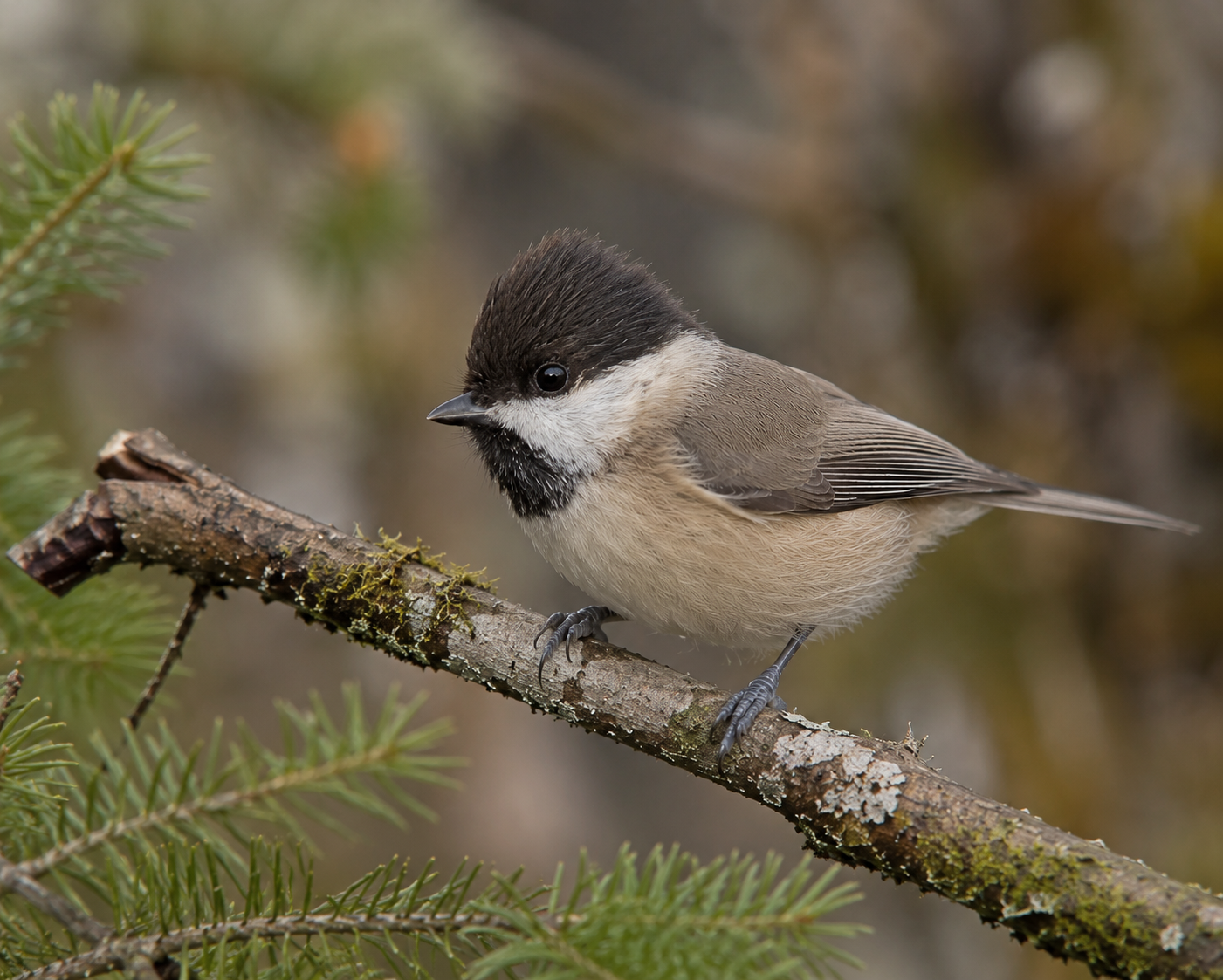
The biggest tit in Europe and the most retiring - a Marsh-Tit-shaped bird half again as large, in subtle pewter, brown, and chalky white. Lives in dry old oak and rocky hillside woodland from the Balkans to the Levant. Rarely seen at feeders; far more likely heard, with a buzzy, scolding 'che-che-cherrrr'.
Widespread and abundant; no known immediate threats to the population.
The heavyweight of European tits. At roughly 14 cm and 20 g, the Sombre Tit is noticeably bigger than Marsh Tit and dwarfs Coal Tit - closer to a small thrush than a typical tit. Side by side, it looks like a Marsh Tit has been scaled up about 50 %.
Range nearly perfectly tracks old-growth oak. Sombre Tits cling to the surviving belts of mature Quercus and plane-tree woodland from the Adriatic east through the Balkans and across Turkey to the mountains of Iran and the Levant. Where these woods have been cut, they vanish; where the woods persist, they're locally common.
Less of a 'tit' in behaviour than its cousins. Sombre Tits spend more time on the ground than any other Paridae, working among rocks and leaf litter for insects, acorns, and pistachio nuts. Their flight is heavier and less acrobatic; they hop more like a small chat than dart like a Blue Tit.
Despite the name, they're not actually drab - they're grey-brown above, chalky white below, with a glossy black cap and a generous black bib. The 'sombre' label comes from older European birding literature where 'sombre' meant 'subdued in color' rather than the modern English sense of 'gloomy'.
The Levant subspecies (P. l. lugens, found in Lebanon, Syria, and Israel) is paler and slightly smaller than the Balkan birds. Some authors have lobbied to split it as a separate species, but DNA work hasn't supported the split - the whole population is treated as one variable species.
Sombre Tits are shy of gardens and rarely visit feeders, but a properly placed nest box in or beside mature oak woodland will be readily adopted. Habitat is the limiting factor: if you don't have mature broadleaf trees within sight, this isn't a realistic garden bird.
Sunflower hearts, suet, acorns, and chopped walnuts on a low platform feeder under cover. Sombre Tits forage more on the ground than other tits, so a quiet, sheltered feeding station near the leaf litter often works where a hanging feeder doesn't.
A 32 mm-hole nest box, 1.5–4 m up on a mature oak or plane trunk, facing east or south-east away from prevailing rain. Quiet, shaded sites well back from human traffic are markedly preferred.
Mature oak is the limiting habitat. A single old oak with standing deadwood is the minimum; a continuous oak grove is ideal. Rocky understorey or fallen logs nearby increase ground-foraging value.
The 32 mm hole admits Sombre Tit comfortably but also lets in Great Tit and Western Rock Nuthatch. Multiple boxes spaced 30 m+ apart reduce conflict; oversized boxes are preferred by Great Tits, so keep the floor to 5"×5".
A shallow, shaded ground-level dish under a tree. Sombre Tits will drink and bathe but avoid open, exposed water sources.
Don't clear mature trees or thin standing deadwood - the species depends on natural cavities and ground litter that takes decades to develop. Don't bother in suburban or treeless habitat; Sombre Tits don't cross open country to colonise isolated boxes.
Southeast European and Middle Eastern oak specialist, resident from the eastern Adriatic across the Balkans and Turkey to the Caucasus, Iran, and Levant. Tied to mature broadleaf woodland - especially old-growth oak and walnut groves.
Resident year-round in mature oak and plane woodland from Slovenia and Croatia south through Bosnia, Serbia, Albania, North Macedonia, Bulgaria, and Greece. Densest in undisturbed mountain forest; absent from the cleared coastal strip.
Probably the species' stronghold. Common in oak woodland from the Aegean coast across Anatolia to the eastern mountains. Tolerates a wider range of broadleaf species here than further west, including pistachio, walnut, and almond groves.
Resident in mountain oak woodland through Armenia, Azerbaijan, Georgia, and the Zagros range of northern Iran. Largely sedentary; some altitudinal movement in winter.
Resident in mountain oak and pistachio groves across Lebanon, Syria, Israel, and Jordan. The paler local subspecies (P. l. lugens) is restricted to the eastern Mediterranean uplands and is increasingly patchy as old-growth groves are felled.
Mature deciduous and mixed woodland with rocky understorey - old-growth oak above all, but also plane, walnut, pistachio, and almond. Likes dry, sun-warmed hillsides with scattered standing deadwood. Avoids pure conifer plantations, scrubland without mature trees, and cleared agricultural land.
Body sized to 5"×5" floor. The 1¼" panel locks out larger nest competitors while letting the Sombre Tit pass cleanly.
More terrestrial than other tits - often forages on the ground among rocks and leaf litter. Lays 5–8 eggs; one brood per year.