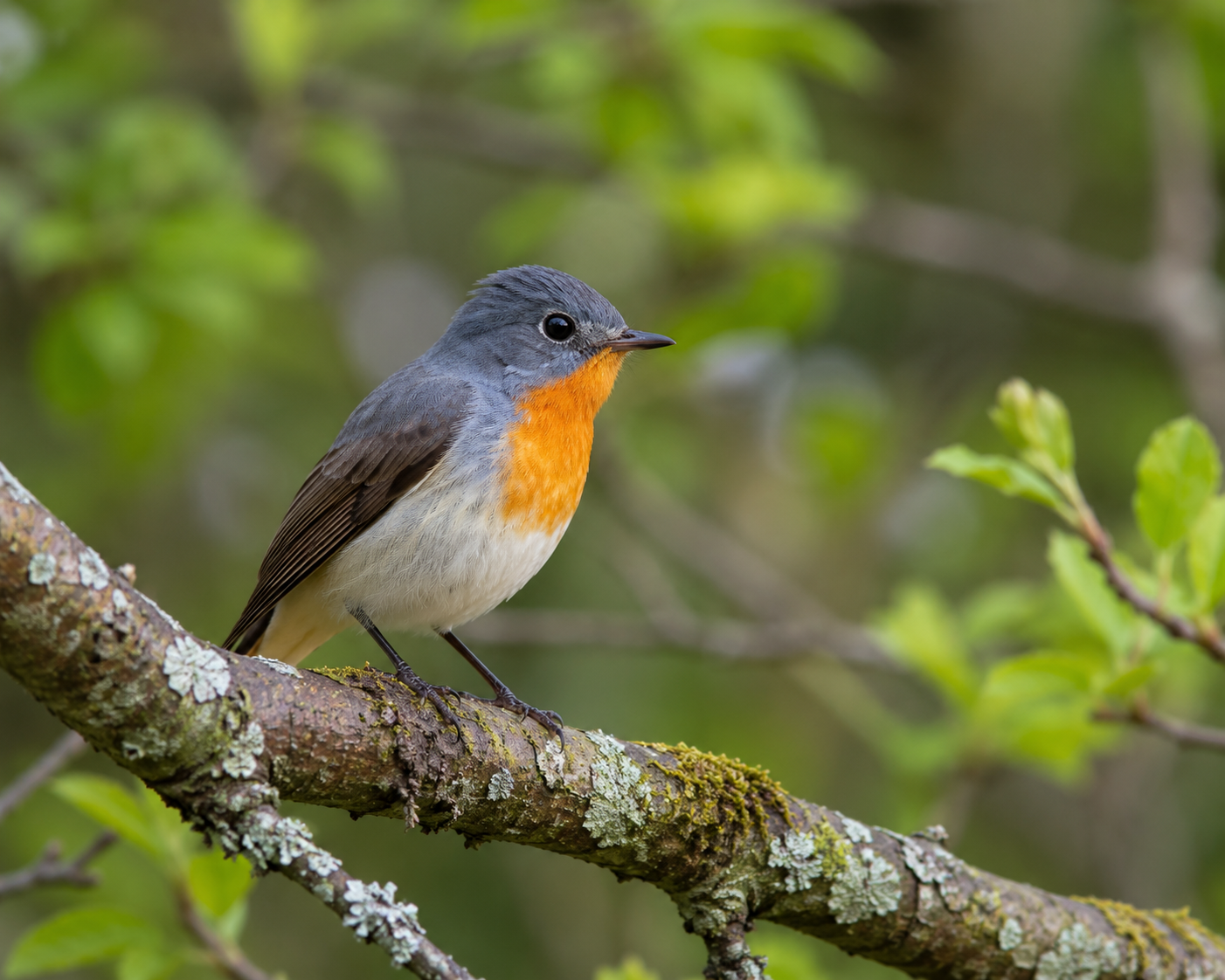
Red-breasted Flycatcher
Back to Birdhouse Guide
Open-Front Nester Open

Red-breasted Flycatcher

Ficedula parva

Tiny European flycatcher with a Robin-like male - sooty grey-brown back, soft orange throat patch, and a constantly twitching white-edged tail. Breeds in mature deciduous forest of central and eastern Europe; winters thousands of miles away on the Indian subcontinent.

IUCN Red List
Least Concern

Widespread and abundant; no known immediate threats to the population.

Floor
5" × 5"
Interior height
6"
Mount height
8–20 ft
Breeds
May–Jul
Broods / yr
1
Cool Facts

Things you didn't know about the Red-breasted Flycatcher

01

The smallest Ficedula in Europe - only about 11–12 cm long, noticeably tinier than its cousins Pied and Collared. Side by side it looks like the family's miniature version: same upright posture, same sallying behaviour, but slimmer, lighter, and faster.

02

The constantly twitching tail is the giveaway. Red-breasted Flycatchers flick their tails up and droop their wings several times a minute, flashing two bright white patches on the outer tail feathers. Even females and first-year birds (which lack the male's orange throat) are identifiable from 30 m away just by this tail-flick alone.

03

Not a true cavity nester. Unlike Pied and Collared, Red-breasted Flycatchers nest in semi-open sites - broken stubs, hollow snapped branches, niches behind loose bark, rot pockets in mature beech. A closed-hole nest box almost never works; an open-fronted shelf mounted under a leaning branch does much better.

04

One of the longest-distance migrants among European passerines. They winter in India, Pakistan, Bangladesh, Nepal, and Sri Lanka - a 6 000+ km journey twice a year. Most pass through the Middle East and Iran on the way south in September and back north in late April.

05

Strongly tied to old-growth beech and hornbeam. Red-breasted Flycatcher populations have crashed in regions where mature mixed forest has been replaced with conifer plantations or young secondary woodland. The species is essentially absent from western Europe (no UK records as a breeder) and has its centre of gravity in the surviving old broadleaf belt from Germany east into Russia.

Attract Them

How to bring the Red-breasted Flycatcher to your yard

Red-breasted Flycatchers are forest-interior birds - they don't visit gardens, don't use feeders, and don't readily adopt standard hole-fronted boxes. The realistic plan is a custom open-fronted shelf mounted high in mature woodland, paired with leaving plenty of broken branches and standing deadwood nearby.

Food

Insectivorous, sallying from a high mid-canopy perch for flying insects. Don't waste time with feeders - they won't visit. Encourage them indirectly by leaving leaf litter, allowing wildflower margins, and avoiding insecticides.

Box placement

An open-fronted box (no hole - a 5"×5" shelf with a 2"-high lip) mounted 3–6 m up on a mature beech, oak, or hornbeam, tucked under a leaning branch or behind a fork. Shaded sites in the forest interior are essential; edge or open sites are typically skipped.

Cover & landscaping

Mature, closed-canopy deciduous woodland with broken stubs and standing deadwood. A single old beech with a snapped limb can hold a pair; thinned or young forest doesn't qualify.

Leave broken branches, dead stubs, and loose bark in place. Red-breasted Flycatchers strongly prefer semi-open natural niches - every broken limb left on the tree is a potential nest site.

Get boxes up by mid-April, before the late-April / early-May arrival from Asia. They prospect quickly and any box installed after the arrival usually misses the season.

Avoid

Don't use standard closed-hole nest boxes - they're consistently ignored. Don't clear deadwood, snap off dead limbs, or thin mature forest. Don't expect them in suburban habitat; this is a true forest-interior species.

Range & Habitat

Where you'll find them

Central- and eastern-European old-growth deciduous specialist that winters on the Indian subcontinent. Breeds in mature beech and hornbeam forest from northern Italy and Germany east through the Baltic states into European Russia, with the densest populations in the Carpathian and Dinaric mountain belts.

By region
  • Central Europe

    Resident breeder in mature beech, hornbeam, and mixed broadleaf-conifer forest across Germany, Czechia, Slovakia, Poland, Hungary, Austria, and Romania. Common but localised - restricted to old-growth and well-buffered woodland.

  • Eastern Europe & Russia

    Densest populations across Belarus, Ukraine, the Baltic states, and European Russia. Recent northward expansion into Finland and central Sweden tracks rising spring temperatures.

  • Northern Italy & Balkans

    Strongholds in the old-growth beech of the Alps, Apennines, Dinaric range, and Carpathians. Patchy in lowland habitat; reliably present wherever mature mountain forest has been left alone.

  • South Asia (winter)

    Non-breeding range from Pakistan east across India, Nepal, Bangladesh, and Sri Lanka. Found in monsoon forest, scrubby gardens, and wooded farmland; very gregarious on the wintering grounds compared with their solitary breeding behaviour.

Habitat preferences

Mature, closed-canopy deciduous or mixed forest - beech, hornbeam, oak, ash, and lime, often with scattered spruce or fir. Needs broken branches, dead stubs, and old rot holes for the semi-open nest site. Avoids young plantations, pure conifer forest, and any cleared or thinned habitat.

mature beech and hornbeam forest mixed deciduous-conifer woodland river-valley broadleaf old-growth mountain forest
10-year local observation heatmap. Click a season above to isolate one band.
Fledgemade Kit

The right house for the Red-breasted Flycatcher

Seasonal Care

When to install. When to clean.

Install by
March–April, before the late-April arrival from southern Asia.
Cleaning
September after fledging.
Central Europe
Resident breeder in mature beech and hornbeam forest from Germany east through Czechia, Slovakia, Poland, Hungary, and Romania. Patchy and shy - usually heard before seen.
Eastern Europe & Russia
Common in mature mixed and broadleaf forest from the Baltic states through Belarus and into European Russia. Northern and Finnish populations are recent expansions.
Northern Italy & Balkans
Resident breeder in old-growth beech of the Alps, Dinaric range, and Carpathians. Strongly tied to mature undisturbed forest - won't use young plantations.
South Asia (winter)
Non-breeding range across India, Pakistan, Bangladesh, Nepal, and Sri Lanka. Migrants travel ~6 000 km each way - among the longer European-passerine migrations.

Distinctive tail-flicking habit - frequently raises tail and droops wings, flashing the white outer tail feathers (the best field mark in any plumage).