 Back to Birdhouse Guide
Cavity Nester
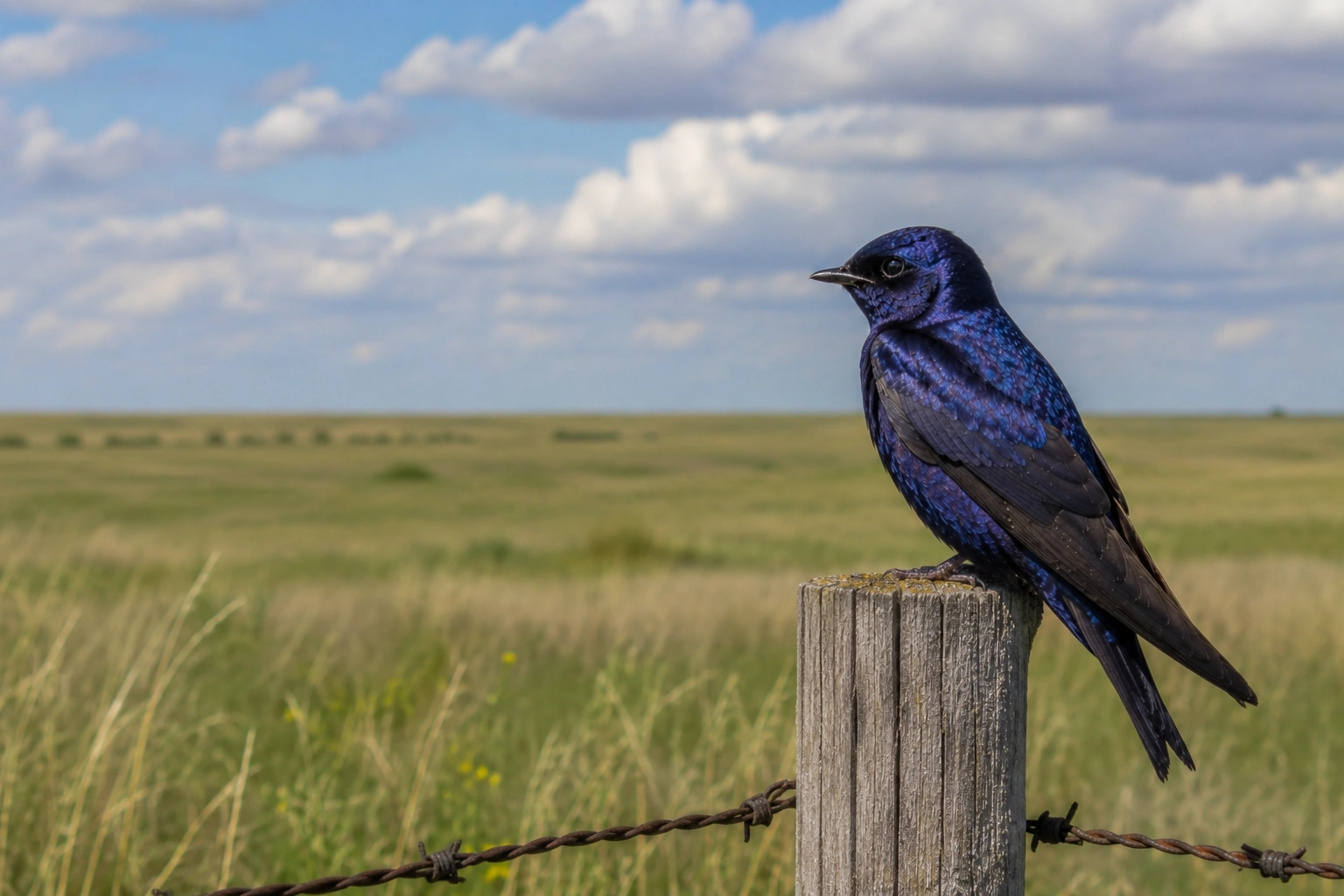
Purple Martin
Progne subis
Back to Birdhouse Guide
Progne subis
The largest North American swallow, with adult males in deep glossy purple-blue. In the East, almost the entire population now depends on human-supplied housing, gourds and apartment-style boxes.
Widespread and abundant; no known immediate threats to the population.
Purple Martins east of the Rockies are almost entirely dependent on human-supplied housing. They'd nearly disappear without nest-box landlords.
Western populations still nest in natural cavities and saguaro cactus holes the old way.
Their fall migration takes them to the Amazon basin in Brazil, where they roost in flocks of hundreds of thousands.
A single Purple Martin pair can deliver hundreds of insects per hour to nestlings, though the 'they eat 2,000 mosquitoes a day' claim is largely a marketing myth.
Purple Martins are colonial cavity-nesters. They want a multi-compartment house, not a single box. Eastern populations specifically prospect for human-supplied housing.
Erect a multi-cavity martin house or gourd rack on a 12–20 ft pole, in the most open part of your yard. At least 30 ft from buildings and 40 ft from tall trees.
Aerial-only, no feeders. Crushed eggshells on a tray help with calcium during nesting.
A nearby pond, lake, or marsh dramatically improves your odds. Open water is essential to their hunting.
Aggressively manage House Sparrows and European Starlings. They'll evict martins. Use entrance hole shapes (crescent or oval) that exclude starlings.
Counterintuitively, less is more. Open sky and open ground around the colony are critical.
Don't put up a single small box. It'll either be empty or claimed by sparrows. Martins want an apartment building.
An aerial insectivore that breeds across the eastern and central US, plus scattered western populations, and winters in South America.
Common breeder from southern Canada through the Mid-Atlantic, Southeast, Midwest, and Great Plains. Strongly dependent on martin houses.
Scattered populations in the Pacific Northwest, California, and the desert Southwest. Western birds use natural cavities much more than eastern birds.
Vast wintering flocks throughout Brazil, especially the Amazon basin and Pantanal.
Open country near water, fields, golf courses, and the edges of small towns. They need open sky for hunting and a clean approach to the colony house.
This species needs a box larger or differently-shaped than our three standard sizes. We make these as one-off prints to the published nest dimensions, with all the species-specific requirements baked in.
Plug entrance holes during winter to prevent sparrow/starling occupation; reopen on the local 'Scout Arrival Date'.