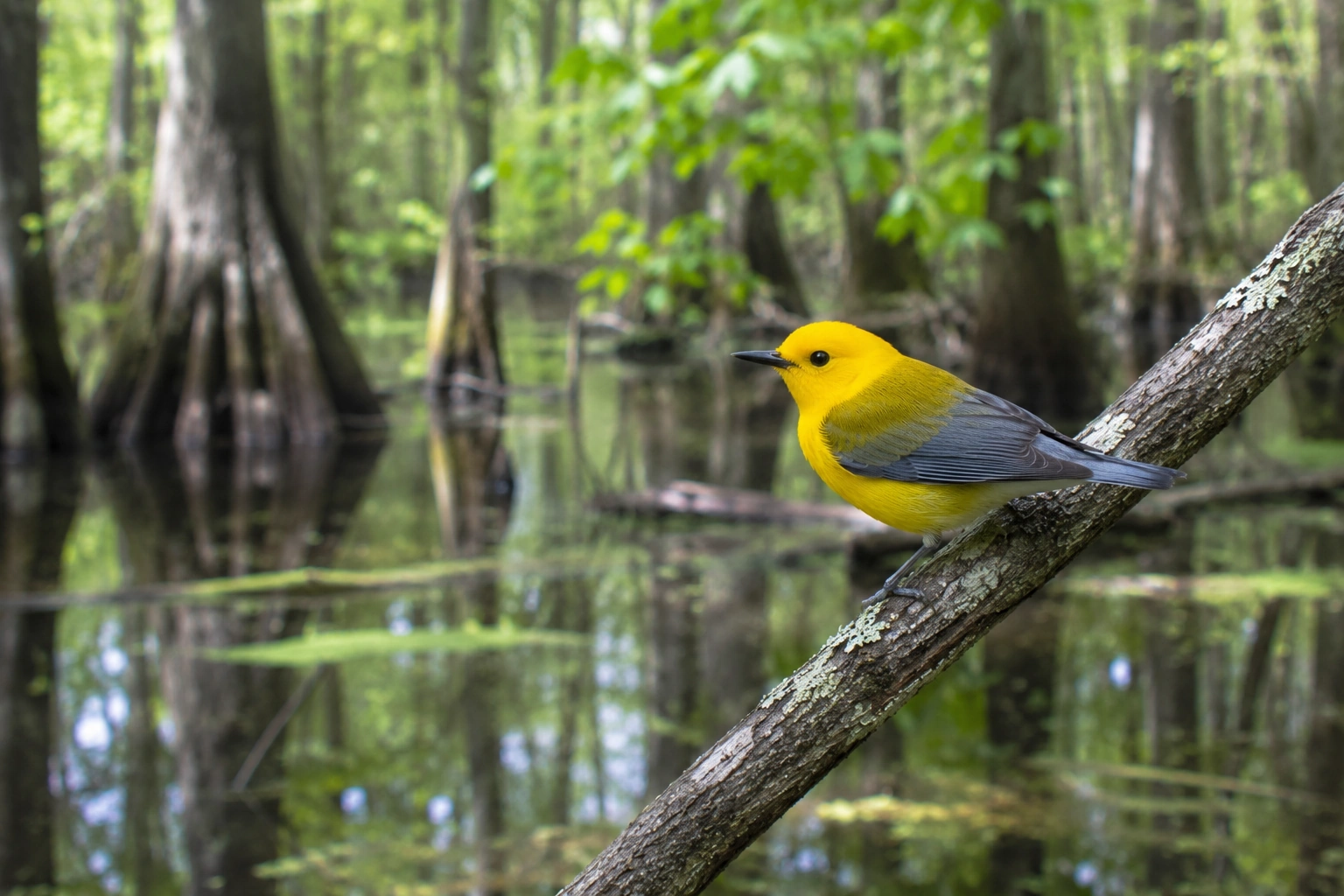
Prothonotary Warbler
Back to Birdhouse Guide
Cavity Nester ⌀ 1.25" Small

Prothonotary Warbler

Protonotaria citrea

Brilliant golden-orange warbler of southern swamp forests, one of only two North American warblers that nest in cavities. The intense yellow head is unmistakable in a dim wooded wetland.

IUCN Red List
Least Concern

Widespread and abundant; no known immediate threats to the population.

Floor
4" × 4"
Interior height
6"
Entrance hole
⌀ 1.25"
Mount height
4–12 ft
Breeds
May–Jul
Broods / yr
1–2
Cool Facts

Things you didn't know about the Prothonotary Warbler

01

One of only two North American warblers that nest in cavities. The other is Lucy's Warbler.

02

Named for the bright yellow hooded robes worn by Catholic prothonotary clerks, a 19th-century field-mark joke that stuck.

03

Strongly tied to standing water, boxes mounted on poles over swamps and slow rivers have the highest occupancy rates.

04

Long-distance migrant, wintering in mangroves and lowland tropical forests from Yucatán south to northern South America.

Range & Habitat

Where you'll find them

Breeds in the southeastern US in flooded bottomland forests, with the northern edge reaching Wisconsin and southern Ontario. Winters from Mexico through northern South America.

By region
  • Southeast US

    Common breeder in cypress swamps and bottomland hardwoods from Texas east through Florida and north along the Mississippi River.

  • Mid-Atlantic

    Sparser breeder north to Maryland, New Jersey, and southern Ontario.

  • Wintering grounds

    Mangroves and lowland tropical forest from Mexico through Central America to Colombia, Venezuela, and Ecuador.

swamp forests flooded bottomland wooded wetlands
10-year local observation heatmap. Click a season above to isolate one band.
Fledgemade Kit

The right house for the Prothonotary Warbler

Seasonal Care

When to install. When to clean.

Install by
By late March
Cleaning
Empty between broods; final clean September
Southeast US
Breeds in flooded bottomland forest; install boxes over water by late March.

Long-distance migrant, winters in mangroves of Central and South America.