Large body + 2½" panel
Body sized to 6"×6" floor. The 2½" panel locks out larger nest competitors while letting the Lewis's Woodpecker pass cleanly.
Back to Birdhouse Guide
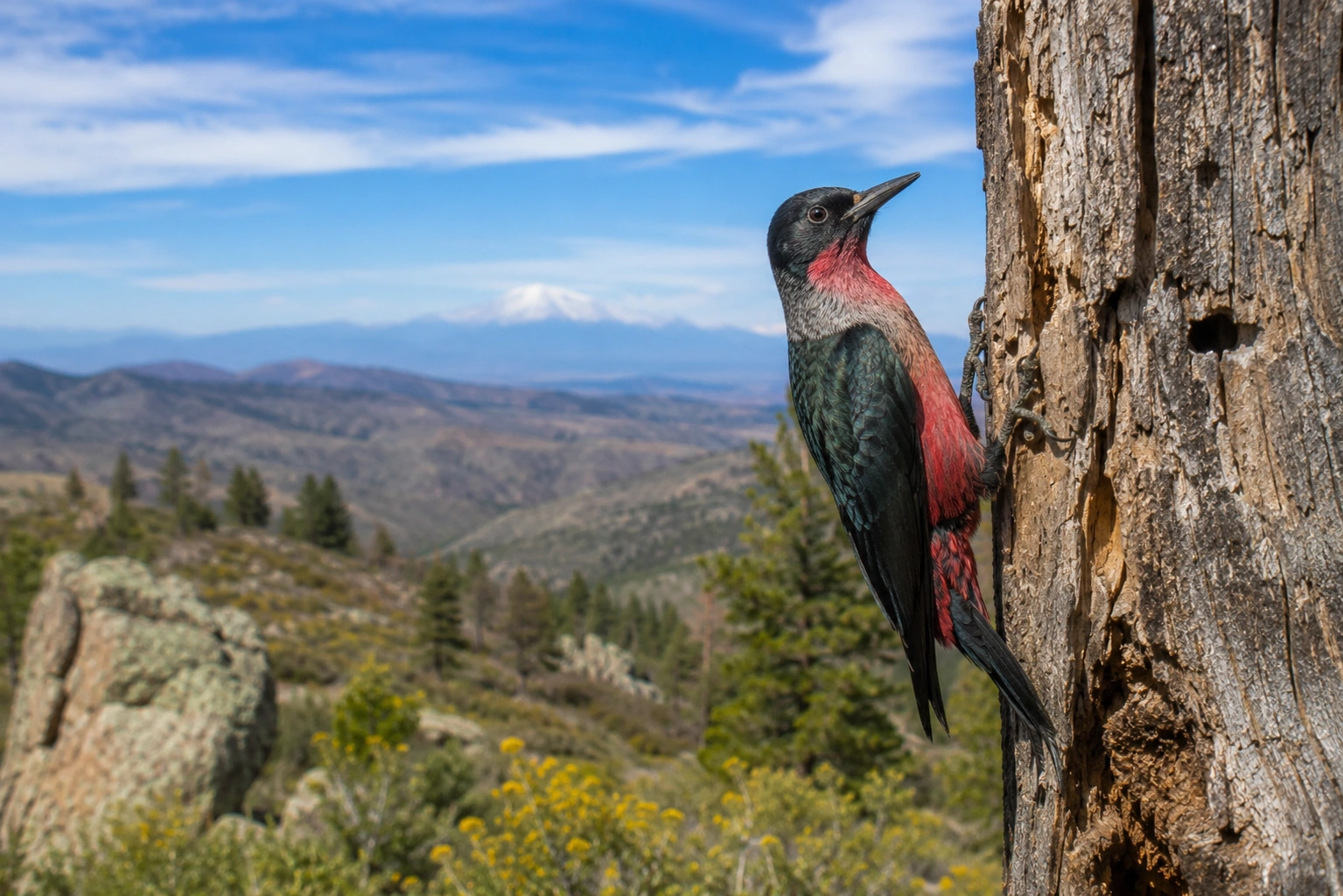
Melanerpes lewis
Striking western woodpecker with iridescent green-black back, dusty pink belly, and silver collar. Hunts flying insects from open perches like a flycatcher, one of the most distinctive birds of the American West.
Widespread and abundant; no known immediate threats to the population.
Named for Meriwether Lewis of the Lewis and Clark Expedition, who first scientifically described it in 1804.
Behaves more like a flycatcher than a woodpecker, hawks for insects on the wing rather than excavating bark.
Population has declined by over 70% since 1970 due to loss of open old-growth and post-burn forest habitat.
The only North American woodpecker with a pink belly; the iridescent green-black back can look entirely black in poor light.
Resident or short-distance migrant in open western forests from southern BC south through the Rockies and Pacific states to northern Mexico.
Breeds in open pine and oak forests from Oregon and Idaho south through California, Nevada, Utah, Colorado, and into the highlands of northern Mexico.
Most common in burned-over and selectively logged pine forests with abundant standing snags.
Body sized to 6"×6" floor. The 2½" panel locks out larger nest competitors while letting the Lewis's Woodpecker pass cleanly.
Catches flying insects on the wing like a flycatcher, unusual for a woodpecker.