 Back to Birdhouse Guide
Cavity Nester
European Roller
Coracias garrulus
Back to Birdhouse Guide
Coracias garrulus
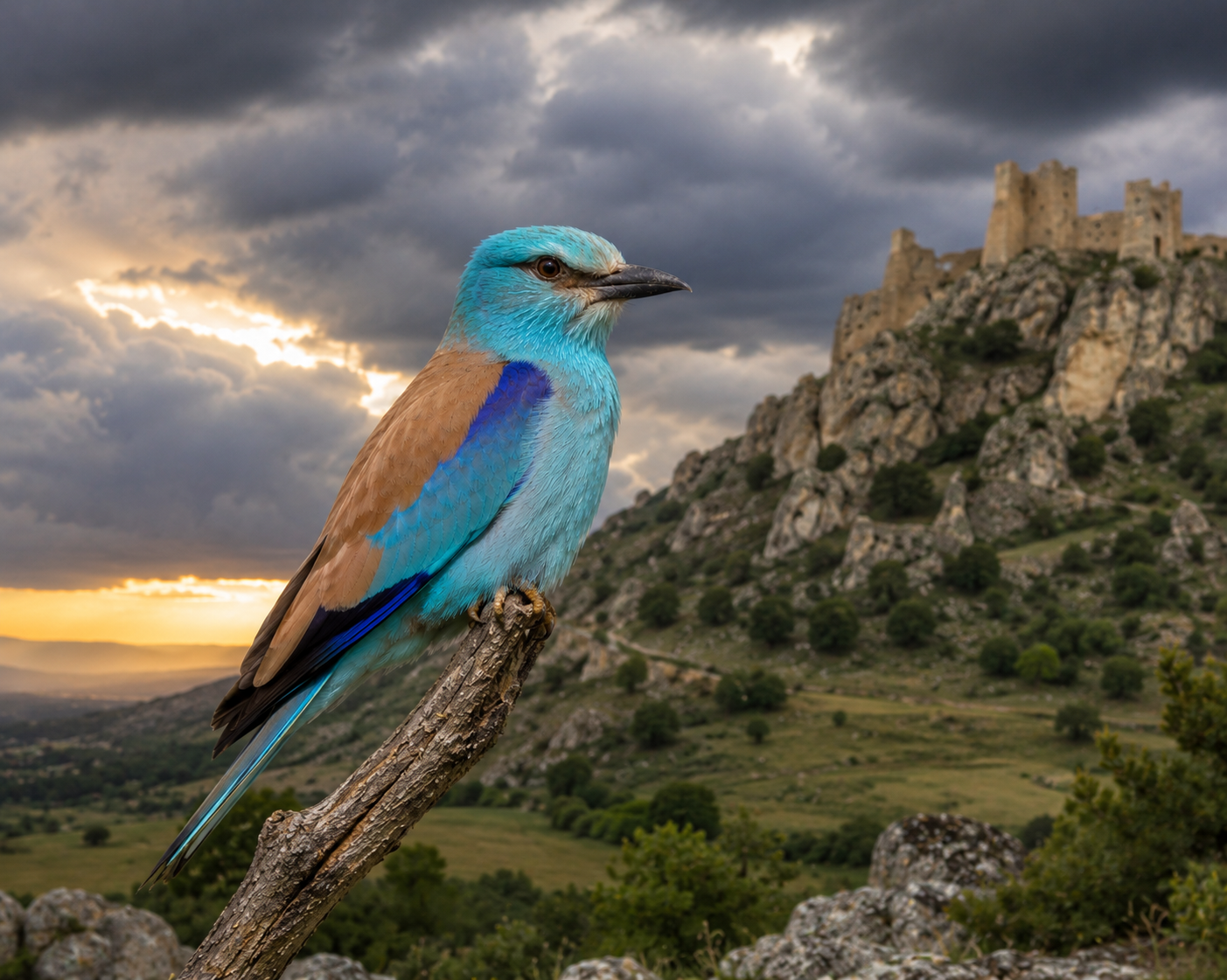
Stunning crow-sized cavity-nester in turquoise and chestnut - Europe's most exotic-looking native bird. Sallies for large insects from open perches, performs aerial 'rolling' courtship dives that give the family its name, and migrates 8 000 km each way to winter in southern Africa.
Widespread and abundant; no known immediate threats to the population.
Europe's most exotic-looking native bird. The European Roller is a crow-sized cavity-nester painted in startling turquoise, cobalt, and chestnut - colors that look misplaced on a European farmland skyline and are usually mistaken for a tropical escapee on first sighting. The bird is a real native, just stunningly off-palette for the continent.
The 'roll' in their name is a courtship aerobatic. Displaying males climb high, then tumble through a series of barrel-rolls and steep dives while calling - a chattering 'rack-rack-rack' carrying across open countryside. The whole family Coraciidae is named for this behaviour; only a handful of bird groups have flight displays this dramatic.
A textbook nest-box conservation success. By the 1990s European Rollers had crashed across central Europe - Hungary alone lost ~80% of pairs by 1996. Coordinated nest-box programmes in Hungary, Bulgaria, Spain, and Slovakia have since doubled or tripled local populations, with measured occupancy rates above 80% in heavily-boxed areas.
Migrates 8 000 km each way to winter in southern Africa. European Rollers leave Europe in August, cross the Sahara via the eastern flyway, and spend the boreal winter in eastern Botswana, Zimbabwe, Mozambique, and northern South Africa - one of the longest non-passerine migrations in the western Palearctic. They return to European breeding sites in late April.
Eats almost anything they can catch by sallying. Their diet is dominated by large insects - grasshoppers, beetles, cicadas, dragonflies - taken from perches by short pursuit flights. They'll also take lizards, small snakes, frogs, and rodents in season. This 'big-bug specialist' habit makes them sensitive to insecticide-heavy agriculture, which is the leading cause of regional declines.
European Rollers are open-country birds, not garden birds. Realistic boxes go up on tall dead trees, electricity pylons, or purpose-built posts in farmland or wood-pasture - the kind of placement used by national conservation programmes in Hungary, Spain, and Bulgaria. In the right habitat, occupancy rates above 80 % are common.
Insectivorous - won't visit feeders. The main thing you can do is reduce insecticide use within several hundred metres of nesting sites, leave grasshopper-rich rough margins, and keep at least some traditional hay-meadow or wood-pasture in the local landscape.
A 70 mm-hole box, 4–8 m up on a tall dead tree, electricity pylon, mature roadside tree, or purpose-built post in open farmland. Mount with the entrance facing east or south-east, away from prevailing weather. The box needs an unobstructed view of open ground for hunting sallies.
Open habitat with scattered mature trees, rough grassland, hay meadows, dehesa, or steppe. Boxes in continuous forest are ignored; boxes in monoculture cropland without rough margins are also ignored. The mix matters.
Pack 25–50 mm of clean wood shavings on the floor before the breeding season. Rollers don't bring much nesting material themselves, and the shavings cushion the eggs against the bare wood.
The 70 mm hole admits Starlings, Jackdaws, Stock Doves, and Little Owls - all of which will occupy a roller box if they get there first. Install boxes by late March before competitors prospect, and consider multiple boxes per site so a displaced pair has options.
Don't open the box during the breeding season - Rollers are vocal, aggressive nest defenders and will abandon if disturbed early. Don't install in closed forest or city centres. Don't expect them in regions outside the breeding range; this is a southern and eastern European bird.
Breeds across southern, central, and eastern Europe through the Caucasus and central Asia, wintering 8 000 km south in sub-Saharan Africa. The European Roller's stronghold is in the dehesa and steppe habitats of Iberia, the Carpathian basin, and the Balkans - wherever open farmland still has scattered old trees with cavities.
Resident breeder across Spain and Portugal in dehesa wood-pasture, traditional olive groves, and open farmland with scattered old trees. The Iberian population is one of Europe's strongholds and has stabilised after nest-box programmes restored local densities.
Densest populations in Hungary, Romania, Bulgaria, Serbia, and southern Slovakia - open agricultural landscapes punctuated by veteran oaks, mature roadside trees, and electricity pylons. Hungarian and Bulgarian box programmes have driven measurable population recovery since the 2000s.
Resident breeder in open countryside with old trees through Italy, Greece, Albania, and the western Balkans. Habitat fragmentation and the loss of old farmland trees remain the main ongoing pressures.
Widespread in steppe and semi-arid open habitat across southern Russia, Ukraine, Kazakhstan, the Caucasus, and into Iran and Iraq. Easternmost breeding birds migrate via the Arabian peninsula to East African wintering grounds.
Non-breeding range concentrated in the savannas of eastern Botswana, Zimbabwe, Mozambique, and northern South Africa. Wintering birds gather in loose flocks of 10–50 at productive grasshopper-rich sites.
Open farmland, wood-pasture, dehesa, and steppe with scattered mature trees - especially veteran oak, ash, white poplar, or pine that holds large natural cavities. Will also use cliff niches, sand banks, building cavities, and disused woodpecker holes. The combining requirement is open ground for hunting plus elevated cavity sites for nesting; closed forest doesn't work.
This species needs a box larger or differently-shaped than our three standard sizes. We make these as one-off prints to the published nest dimensions, with all the species-specific requirements baked in.
Big, conspicuous, and aggressive nest defenders - they'll dive-bomb predators and humans approaching the box. Don't open the box during the breeding season.