Medium body + 1¼" panel
Body sized to 5"×5" floor. The 1¼" panel locks out larger nest competitors while letting the Eurasian Wryneck pass cleanly.
Back to Birdhouse Guide
Jynx torquilla
A cryptically barked little woodpecker that breaks every rule of the family - it doesn't drill, it uses cavities, it eats almost nothing but ants, and when threatened it twists its neck in slow snake-like coils that gave the species its name. A vanished British breeder, a thriving central-European migrant, and one of the most-overlooked nest-box species in Europe.
Widespread and abundant; no known immediate threats to the population.
A woodpecker that refuses to act like one. The Eurasian Wryneck is the only Old World member of the family Picidae that doesn't drill its own cavity - it uses existing tree holes, old woodpecker excavations, and (especially) nest boxes. It also lacks the stiff tail feathers other woodpeckers use as a prop, and rarely climbs vertical trunks. About the only obvious woodpecker traits left are the zygodactyl feet and the long sticky tongue.
Eats almost nothing but ants. The species' diet is roughly 99% ants and ant larvae - adults snake out a 2-inch sticky tongue to lift workers and pupae directly from ant nests on the ground. Where pasture and traditional orchard floors hold rich ant communities, Wrynecks thrive; where insecticides have stripped the ant biomass, they vanish within a generation.
Named for a remarkable threat display. When cornered in the nest, Wrynecks twist their necks in slow, snake-like coils, hiss, ruffle their feathers, and stare with closed pupils - putting on what is essentially a snake impression to scare off predators. The name 'wryneck' (and Latin Jynx, 'twister') refers to this writhing; the English word 'jinx' comes from the same root via folk magic.
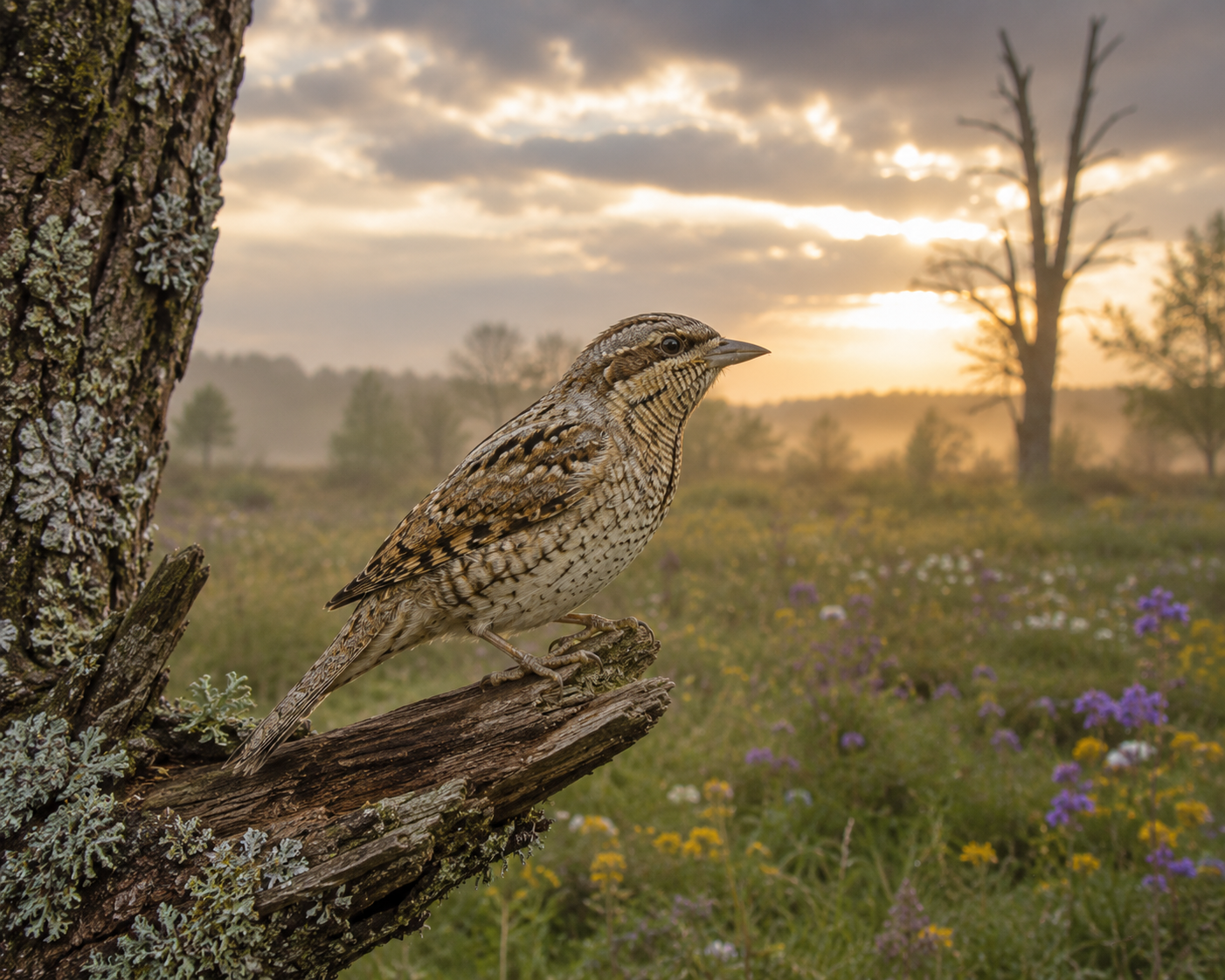
Famously cryptic. Wrynecks are camouflaged in such finely vermiculated browns, greys, and creams that they vanish against bark or autumn leaves. Most sightings are accidental - a bird flushed from the ground, or a glimpse at a box entrance - and identification is often easier by call (a fast, falcon-like 'que-que-que-que-que') than by appearance.
UK has lost them as a breeder. Once a regular breeding bird across southern England and the Scottish Highlands, the Wryneck declined steadily through the 20th century and stopped breeding in Britain by the 2000s. They're still annual migrants to British coasts in spring and autumn, but the breeding population is gone - a stark contrast to thriving populations across central Europe.
Wrynecks are happy to use standard 32 mm-hole nest boxes wherever short pasture or sandy ground supports a healthy ant community. The two ingredients have to match - boxes without ants nearby are ignored; ant-rich habitat without cavities forces birds to look elsewhere. Get both right and they're one of the more rewarding box species in central Europe.
Insectivorous - ants almost exclusively. Won't visit feeders. The conservation lever is the pasture: leave a few square metres of unmown, unsprayed short grass with sandy patches where ant colonies thrive. Even a single sun-warmed corner of a garden lawn helps.
A 32 mm-hole box, 2–4 m up on a mature fruit tree, mature pollarded tree, or sun-warmed east-facing wall. Wrynecks pick sun-exposed boxes over shaded ones (the opposite of Collared Flycatcher), and prefer sites with short pasture or bare ground within 20 m for foraging.
Don't add wood shavings or any nest material. Wrynecks lay their eggs directly on the bare floor of the cavity - sometimes after evicting an existing tit nest by tossing the eggs and lining out of the box.
Mature orchard, wood-pasture, or open mixed woodland edge within a few hundred metres. Wrynecks won't cross large open distances; the box has to sit in or beside their foraging habitat.
The 32 mm hole admits Great Tit, Tree Sparrow, Pied Flycatcher, and various nuthatches - all of which prospect from February while Wrynecks arrive in May. Wrynecks will sometimes evict existing tit broods, but offering multiple boxes per site reduces conflict and keeps both species breeding.
Don't apply insecticides anywhere near the boxes - ant biomass is the limiting resource, and herbicides indirectly hurt ants too. Don't mount in deep shade or in dense forest interior; Wrynecks need open sun-warmed habitat. Don't expect them in UK gardens; the species is no longer breeding in Britain.
Long-distance migrant breeder across the Palearctic, from Iberia to Japan, wintering in sub-Saharan Africa and southern Asia. Strongholds in Mediterranean orchards, central-European wood-pasture, and the Eastern European broadleaf belt. Lost as a UK breeder; rare passage migrant only.
Lost as a regular breeder. Formerly bred in southern England (Kent, Sussex) and the Scottish Highlands; currently a regular spring and autumn passage migrant only, with annual records on east-coast headlands. Nest boxes won't recover a UK breeding population - the ant-rich pasture habitat is what's missing.
Densest populations in southern France, Switzerland, Bavaria, Czechia, Hungary, Slovenia, Italy, Greece, and Iberia. Recent declines tied to orchard loss and the disappearance of ants from intensively-farmed land. Swiss and Bavarian nest-box programmes have stabilised local populations and serve as the European recovery models.
Widespread breeder across the broadleaf and mixed-forest belt from the Baltic states through Belarus, Ukraine, European Russia, and into Siberia. Northern populations are strongly migratory; southern breeders shorter-distance migrants.
Resident or short-distance migrant breeder in northeastern China, Korea, and the Japanese islands. The Japanese population is one of the more accessible places to see breeding birds, with reliable annual nesting in mountain orchards.
Non-breeding range across the Sahel and tropical Africa - Senegal east through Mali, Niger, Chad, Nigeria, Sudan, Ethiopia, and into Kenya. Wintering birds are largely ground-foraging in dry savanna, behaviourally very different from the breeding habit.
Traditional orchards, vineyards, wood-pasture, and open broadleaf woodland edges with short-grazed pasture or bare ground rich in ants. Mature fruit trees with natural cavities are the classic setting. Avoids dense closed forest (despite being a woodpecker), pure conifer, and intensively-managed monoculture farmland.
Body sized to 5"×5" floor. The 1¼" panel locks out larger nest competitors while letting the Eurasian Wryneck pass cleanly.
Long-distance migrant - gone from Europe August through April. Box must be up by early April for the May arrival. Will sometimes evict existing tit broods from a box.