Small body + 1⅛" panel
Body sized to 4"×4" floor. The 1⅛" panel locks out larger nest competitors while letting the Eurasian Tree Sparrow pass cleanly.
Back to Birdhouse Guide
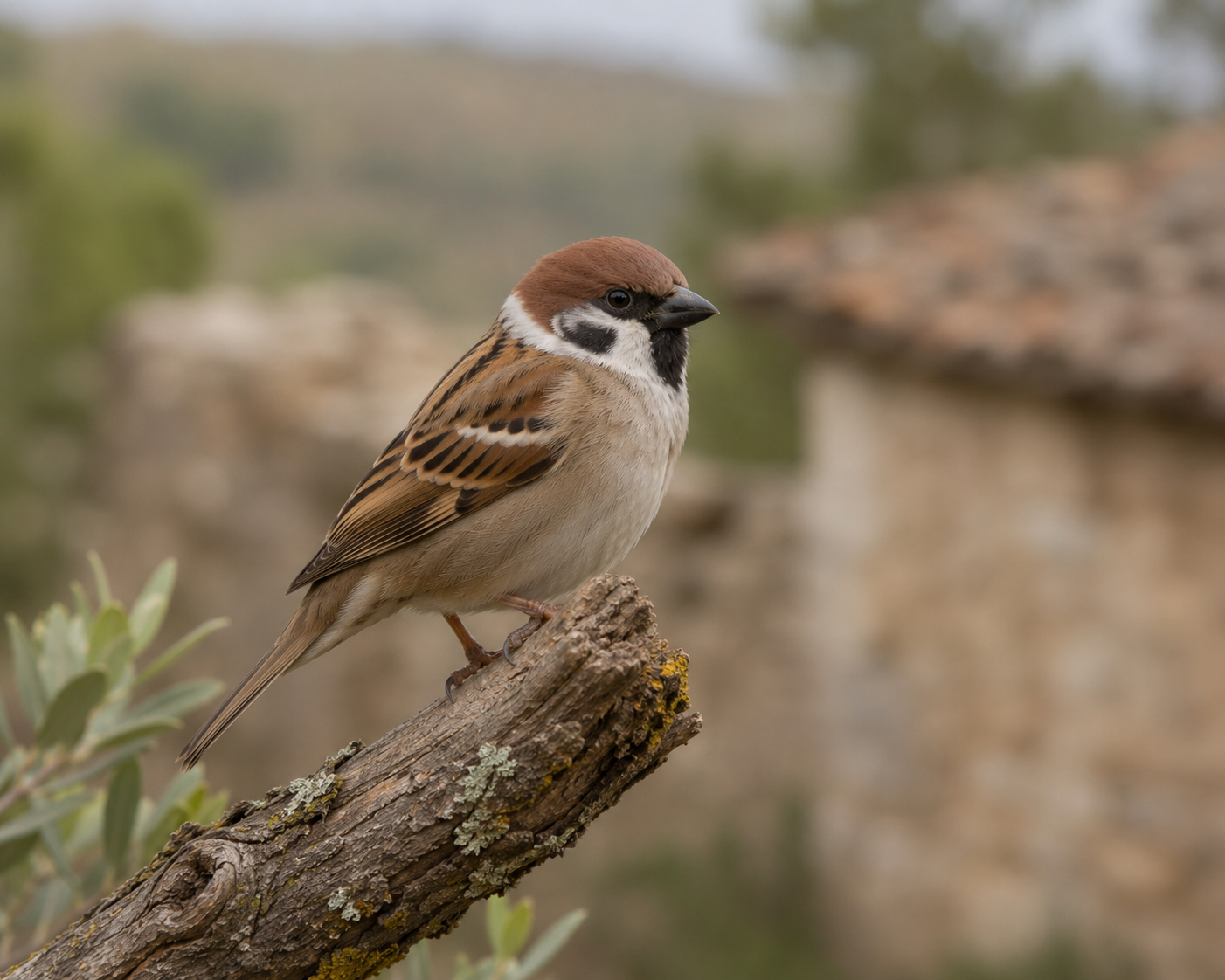
Passer montanus
The chestnut-crowned, white-collared cousin of the House Sparrow - neat, both-sexes-identical, more rural and arboreal than its city-dwelling relative. UK Red-listed and dramatically declined across western Europe; still common across Asia, where it fills the urban niche House Sparrow occupies in Europe.
Widespread and abundant; no known immediate threats to the population.
Both sexes look identical - unusual in the sparrow family. House Sparrow males and females look quite different; Tree Sparrows are neat little carbon copies of each other, with the same chestnut crown, black cheek spot, and white collar regardless of sex. Even juveniles match the adults closely by their first autumn.
Swaps urban niches with House Sparrow across Eurasia. In Europe, House Sparrow dominates cities and Tree Sparrow takes the countryside. In East Asia, the roles reverse: Tree Sparrows are the urban birds, abundant on Tokyo, Beijing, and Seoul streets, while House Sparrow is either absent or scarce. Same species, completely different ecological role 8 000 km apart.
UK populations crashed more than 90 % from the 1970s peak. Farmland intensification - loss of hedgerows, autumn-sown crops replacing winter stubble, herbicide use clearing the weed-seed food supply - cut Tree Sparrow numbers from millions to tens of thousands. The species is UK Red-listed, and grouped nest boxes plus winter seed provision are the proven local recovery tools.
A small introduced population lives in St. Louis, Missouri. A handful of birds released in 1870 founded a population that's persisted but barely spread - they now occupy a roughly 200-mile radius of St. Louis through Illinois and Iowa, where they overlap awkwardly with House Sparrow and have stayed regionally confined for 150 years.
Colonial nesters with a strong preference for clustered cavities. Tree Sparrows pick sites with neighbours within sight - small 'colonies' of 5–20 pairs share hedgerows, walls, or barn complexes. Multi-chamber 'sparrow terraces' (3+ compartments per unit) outperform single boxes by a wide margin in conservation studies.
Tree Sparrows respond strongly to grouped nest boxes plus a year-round seed supply. The cluster matters - solo boxes are often ignored, but a row of 3–6 boxes on the same fence or wall draws colonies in within a season or two if the local population isn't extinct.
Mixed seed (millet, sunflower hearts, oat groats, niger), hung in feeders or scattered on a low tray. Winter seed provision is the single biggest help - UK studies tie population recovery directly to year-round seed availability in farming landscapes.
A 28 mm-hole box, 2–4 m up on a wall, fence post, or mature tree. The 28 mm hole intentionally excludes House Sparrow (which uses 32 mm), so Tree Sparrows hold the cavity unchallenged. Group 3–6 boxes spaced 5–10 m apart on the same row for best uptake.
Mature hedgerows, copses, or wooded field margins within 100 m of the box. Tree Sparrows commute short distances between nest and feeding sites; isolated boxes far from cover are rarely adopted.
Leave winter stubble, weedy field corners, or feeder seed available all winter. Tree Sparrows are non-migratory but susceptible to hard-winter mortality; supplemental seed bridges the bottleneck.
The 28 mm hole keeps House Sparrow out. Tit competition (Blue, Great, Coal) is real - tits prospect from February while Tree Sparrows start in April, so the tits often hold the cavity. Group boxes so a Tree Sparrow pair displaced from one box has neighbours' options.
Don't isolate single boxes in open habitat - they're a colonial species. Don't apply broad-spectrum herbicides on nearby field margins; weed seed is the main winter food. Don't enlarge the hole to 32 mm - that just hands the box to House Sparrows.
Native across the Palearctic from western Europe through to Japan, plus a small introduced North American population. Common and stable across Asia; sharply declined in northwest Europe - UK Red-listed - and patchy in Mediterranean Europe.
UK Red List species; population down >90 % since the 1970s. Best remaining strongholds are East Anglia, Yorkshire, the Welsh borders, and parts of central Scotland - areas with surviving traditional mixed farming. Grouped nest boxes paired with winter seed plots make a measurable local difference.
Widespread but declining in northwest Europe (France, Germany, Low Countries); more stable in central and eastern Europe where traditional low-intensity farming persists. Mediterranean populations are patchy and tied to traditional orchards and vineyards.
Resident breeder across Scandinavia, the Baltic states, Belarus, Ukraine, and European Russia. Northward range expansion in Norway and Sweden tracks milder winters. Wintering birds form mixed flocks with Greenfinches and Yellowhammers around farmsteads.
Abundant - fills the urban-sparrow niche that House Sparrow fills in Europe. Standard street bird in Tokyo, Beijing, Seoul, and most East Asian cities, where House Sparrow is either absent or scarce. Several local subspecies recognised.
A small introduced population centred on St. Louis since 1870. Confined to roughly the St. Louis metropolitan area and adjacent farmland in Illinois and Iowa; has not expanded significantly despite 150+ years of opportunity.
Traditional mixed farmland with hedgerows, copses, and old buildings; village edges with orchards; wood-pasture and riverbank tree lines. Needs natural cavities (or boxes), nearby seed sources (weedy field margins, winter stubble, garden feeders), and breeding-season insects for chicks. Avoids dense forest interior, treeless monoculture cropland, and high mountains.
Body sized to 4"×4" floor. The 1⅛" panel locks out larger nest competitors while letting the Eurasian Tree Sparrow pass cleanly.
Colonial - pairs prefer clusters of nest sites with neighbours within sight. Multi-chambered nest boxes ('sparrow terraces') with 3+ compartments work better than single units.