 Back to Birdhouse Guide
Cavity Nester
Eurasian Hoopoe
Upupa epops
Back to Birdhouse Guide
Upupa epops
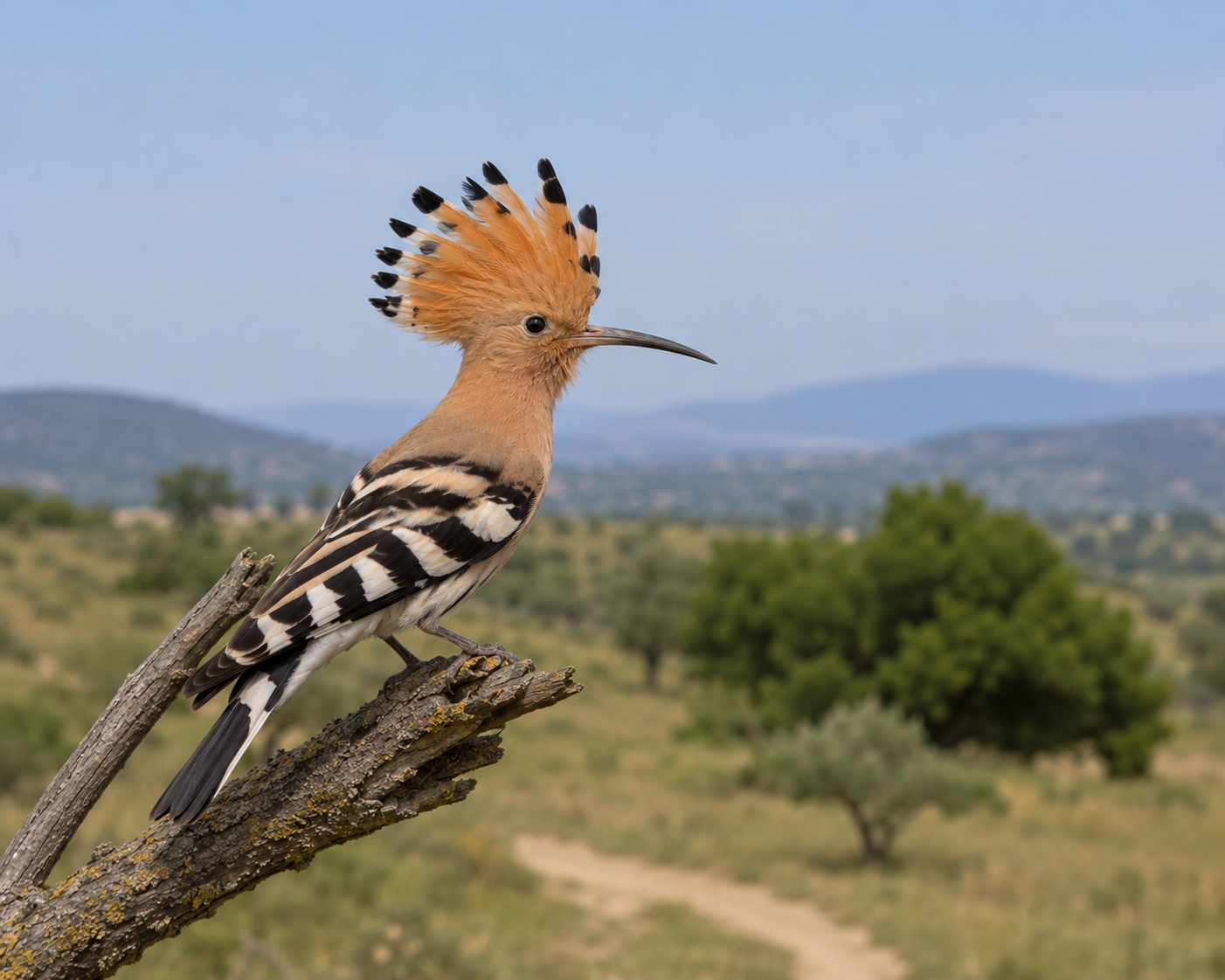
Stunning cinnamon, black-and-white cavity nester with a huge erectile crown crest - instantly recognisable across Eurasia and Africa. Famous for its 'hoop-hoop-hoop' call (the source of the name) and for the conservation nest-box programmes that have rebuilt local populations from Switzerland to Spain.
Widespread and abundant; no known immediate threats to the population.
The 'hoop-hoop-hoop' call is the source of just about every name the species has. Latin upupa, Greek epops, French huppe, Italian upupa, German Wiedehopf, Arabic hudhud - every language hears the same three-note call and renames the bird after it. Few species in the world are so consistently onomatopoeic across cultures.
The female and chicks deploy a chemical-warfare defence. The uropygial (preen) gland of nesting females and nestlings produces a foul-smelling secretion that they smear on plumage and the nest cavity. Bacterial-resistance studies have shown it's a genuine antibacterial AND a predator deterrent - most mammalian raiders give up on hoopoe nests because of the stench.
A textbook conservation-by-nest-box species. The Swiss Valais population had crashed below 100 pairs by the 1970s after orchard intensification destroyed natural cavities. A coordinated programme installed ~700 boxes on barns, fence posts, and pollarded trees from 1979 onward; the population climbed past 800 pairs and has held there for two decades.
Walks more than most cavity nesters. Hoopoes spend long stretches stalking across short pasture, lawns, and bare ground, probing with the long curved bill for mole crickets, beetle larvae, and earthworms. The crest - flared when alarmed or displaying, folded flat in flight - is the field giveaway when one is striding across a meadow head-down.
One of the more cosmopolitan single-species birds on Earth. Eurasian Hoopoes breed from Spain and Morocco east to Japan and south to South Africa, occupying nearly every open-country habitat in the Old World except the Sahara core and the high Arctic. The African and southern Asian populations are resident; northern breeders migrate up to 5 000 km.
Eurasian Hoopoes are open-country birds that take readily to nest boxes mounted on barns, fence posts, old walls, or pollarded trees in traditional farming landscapes. The Swiss Valais programme is the model - boxes plus retained orchards plus light grazing equals a recovered local population.
Insectivorous and ground-foraging - won't visit feeders. The biggest contribution is leaving short-grazed grassland or unfertilised lawn (no pesticides, no excessive nitrogen) so soil invertebrates like mole crickets, beetle larvae, and earthworms remain abundant.
A 65 mm-hole box, 2–4 m up on a barn wall, fence post, pollarded tree, or purpose-built post. Hoopoes will accept boxes much lower than Rollers or Owls - height matters less than the open-ground feeding area within 100 m. East- or south-east-facing entrance keeps weather out.
Open grassland, pasture, orchards, vineyards, or wood-pasture with at least some bare ground for foraging. Lawn-style trimmed grass in a garden surrounded by pasture works; manicured suburban gardens without bare ground or pasture nearby do not.
Don't add wood shavings. Hoopoes nest on bare wood and the female secretes a pungent anti-predator fluid; shavings just absorb the secretion and make cleanup harder. The smell from a hoopoe-occupied box is real - gloves and a strong stomach are part of the autumn clean.
The 65 mm hole admits Starlings, Jackdaws, Stock Doves, and Little Owls. Install boxes by mid-March before competitors prospect, and offer multiple boxes per site if you can. Hoopoes will sometimes evict Starlings but rarely Jackdaws.
Don't use insecticides on nearby grass or orchard floor - soil invertebrate biomass is the limiting resource. Don't 'tidy' open pasture into manicured lawn; rough corners and unfertilised margins are part of what makes the habitat work. Don't open the box during the breeding season.
One of the world's most widely distributed birds, breeding across the entire Old World from Iberia and Morocco to Japan and South Africa. European populations are mostly long-distance migrants wintering in sub-Saharan Africa; Mediterranean, Asian, and African breeding birds are largely resident.
Common resident breeder in dehesa, traditional orchards, vineyards, and olive groves across Spain, Portugal, southern France, Italy, Greece, Cyprus, Malta, and the Maghreb. Numbers are stable or recovering where traditional low-intensity farming persists.
Long-distance migrant breeder in France, Switzerland, Germany, Austria, Czechia, Slovakia, Hungary, Romania, and parts of Poland and the Baltic states. The Swiss Valais and Bavarian populations are conservation-box success stories; northward range expansion (Belgium, Netherlands) has been documented since the 2000s.
Widespread breeder in steppe, agricultural landscapes, and wood-pasture from European Russia through the Caucasus to Kazakhstan and into Mongolia and northern China. Northern populations migrate; southern populations are resident.
Largely resident across the Indian subcontinent, southeast Asia, and most of sub-Saharan Africa. The African and southern Asian populations are the sink for migrating European birds and the source of the species' year-round occurrence in the tropics.
Open habitat with scattered mature trees, walls, or banks - orchards, vineyards, dehesa, traditional pasture, wood-pasture, dry grassland, village edges. Needs bare or sparsely-vegetated ground for foraging (probing for soil invertebrates) plus elevated cavity sites for nesting. Avoids closed forest, monoculture cropland without margins, and high-altitude habitat.
This species needs a box larger or differently-shaped than our three standard sizes. We make these as one-off prints to the published nest dimensions, with all the species-specific requirements baked in.
The female secretes a pungent fluid during incubation; nestlings squirt feces from the nest entrance. The smell is real and the conservation message is real - the smell is the species' anti-predator defence and should be tolerated, not 'fixed'.