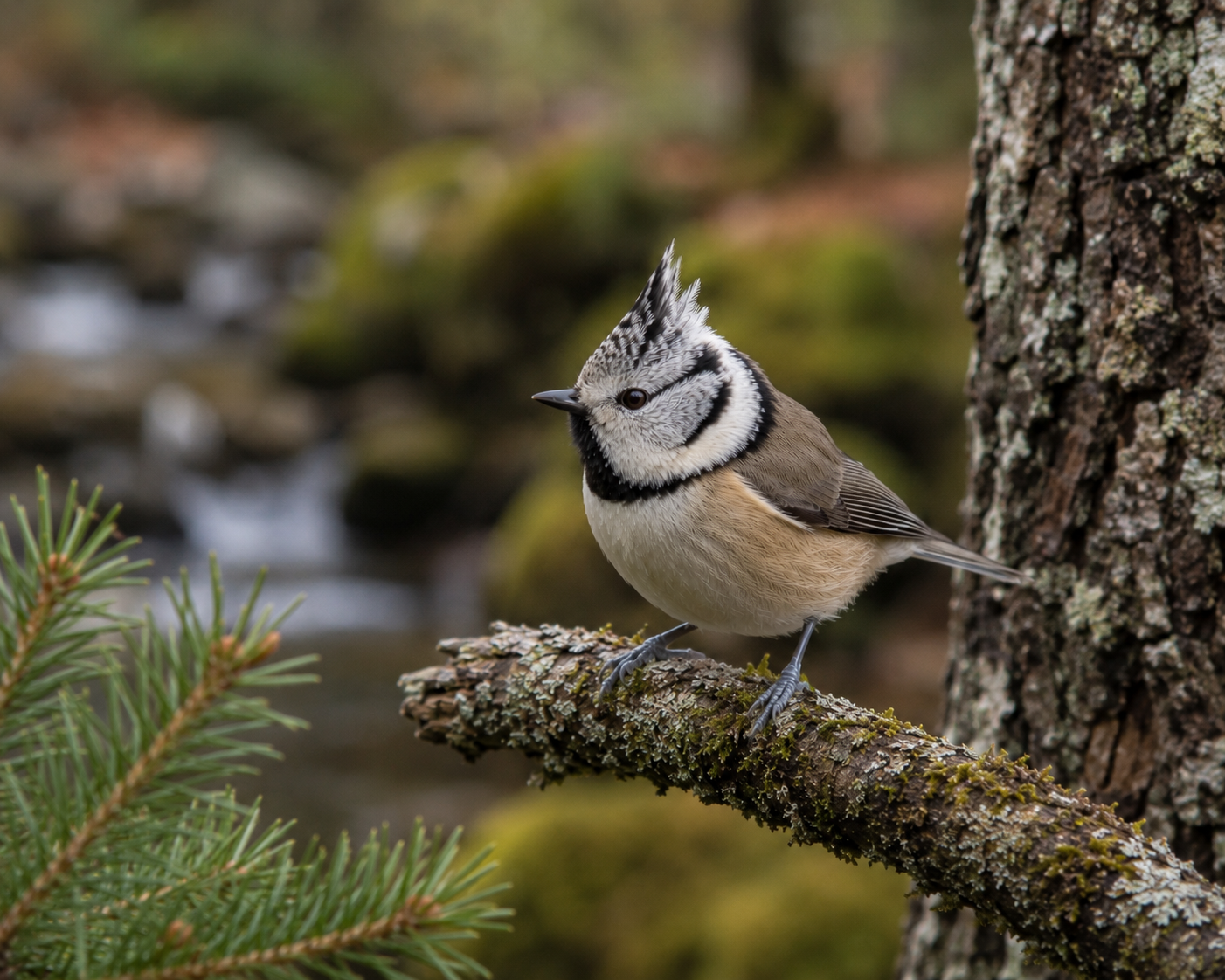
Crested Tit
Back to Birdhouse Guide
Cavity Nester ⌀ 1.0" Small

Crested Tit

Lophophanes cristatus

The only tit in Europe with a spiky black-and-white crest, unmistakable once you've seen it. A pine-forest specialist with a soft trilling 'perurrrrr' call, found wherever mature Scots pine or Norway spruce stands have been left alone.

IUCN Red List
Least Concern

Widespread and abundant; no known immediate threats to the population.

Floor
4" × 4"
Interior height
8"
Entrance hole
⌀ 1.0"
Mount height
4–12 ft
Breeds
Apr–May
Broods / yr
1
Cool Facts

Things you didn't know about the Crested Tit

01

Europe's only crested tit. The spiky black-and-white crest (a triangular crown of feathers that flicks up when the bird is alert) makes a Crested Tit unmistakable - no other European songbird has anything like it. The juveniles' crests are barely visible at first and grow in over their first autumn.

02

Almost entirely tied to mature Scots pine and Norway spruce. They feed by hanging upside-down from cone clusters and probing under bark with their stubby bills, working spots no other tit can reach. Lose the conifers and the bird disappears within a season - they don't switch to broadleaf woodland.

03

Unlike most tits, Crested Tits excavate (or enlarge) their own nest cavities. They favour soft rotten pine stumps and dead branches, hammering out a hole big enough for a brood. A nest box pre-stuffed with wood shavings mimics that 'soft punky wood' starting condition perfectly.

04

The UK population is a Caledonian relic. Crested Tits in Britain are confined to the ancient pine forests of the Scottish Highlands - Abernethy, Strathspey, Glen Affric - descendants of the post-glacial Scots pine forest. They never recolonised southern Britain after the last ice age, despite being common just across the Channel.

05

Their soft trilling 'perurrrrrrrr' call is the easiest way to find them. Crested Tits are quiet, well-camouflaged against pine bark, and stay high in the canopy. The trill - sounding like a small motor revving - gives them away long before you see them, even from 30 m up in the trees.

Attract Them

How to bring the Crested Tit to your yard

Crested Tits will only come to gardens that border or contain mature conifer woodland. If you have a stand of old Scots pine or Norway spruce within sight, a properly placed nest box is realistic; otherwise this is one to plan a holiday around instead.

Food

Sunflower hearts, peanut granules, and suet pellets, hung on or beside a conifer trunk rather than in the open. Crested Tits cache obsessively in autumn - expect them to grab and fly rather than perch and eat.

Box placement

A 25 mm-hole nest box on a mature Scots pine or Norway spruce, 1.5–4 m up, facing east or south-east away from prevailing rain. Pack the floor with 25 mm of pine shavings so they have something to excavate; an empty box is less attractive to them.

Cover & landscaping

Mature Scots pine is the limiting habitat. One or two old pines within 10 m of the box is the minimum; a continuous pine canopy is ideal. Younger plantations (under 40 years) rarely hold them.

Competitors

A strict 25 mm hole excludes Great Tit and House Sparrow. Coal Tits and Goldcrests share the habitat; competition with Coal Tits for cavities is real - put up multiple boxes spaced 25 m+ apart.

Leave standing dead pines and rotten stumps alone. Crested Tits excavate their own nests in punky pine wood, so even a single dead snag in a garden multiplies the value of the habitat.

Avoid

Don't tidy or clear-fell mature conifers - once the pine cover goes, the bird leaves. Don't bother in a treeless or broadleaf-only garden; Crested Tits won't cross open country to reach an isolated box.

Range & Habitat

Where you'll find them

A widespread Palearctic conifer specialist, resident across mainland Europe wherever mature pine or spruce forest survives. In the British Isles, restricted to the ancient Caledonian pine remnants of the Scottish Highlands.

By region
  • Scotland (UK)

    The entire UK population lives in the Caledonian pine remnants of the Highlands - Abernethy, Strathspey, Rothiemurchus, Glen Affric. Around 1,000–2,000 pairs, all dependent on mature Scots pine with standing deadwood. Absent from the rest of the UK and from Ireland entirely.

  • Continental Europe

    Common from the Pyrenees and Alps through France, the Low Countries, Germany, Poland, and across Scandinavia. Densest in old-growth Scots pine and Norway spruce; tolerates plantations as long as standing deadwood is left in place for excavation.

  • Mediterranean Mountains

    Resident in the conifer belts of the Iberian peninsula, the Apennines, the Balkans, and Greece. Descends to lower elevations in winter. The Mediterranean subspecies (L. c. weigoldi in Iberia) is slightly darker than the northern form.

  • Eastern Europe & Russia

    Resident across the boreal pine belt as far east as the Urals. Common throughout, always closely tied to mature pine and spruce cover. Drops out east of the Urals where the Siberian Tit takes over.

Habitat preferences

Strictly tied to mature conifer forest - Scots pine (Pinus sylvestris) above all, with Norway spruce as a strong second choice. Needs standing deadwood and soft rotten stumps for nest excavation. Will tolerate mixed conifer-broadleaf woodland and well-treed gardens with old pines, but won't persist in pure broadleaf habitat.

mature conifer forests Scots and Caledonian pine spruce plantations with standing deadwood wooded gardens with old conifers
10-year local observation heatmap. Click a season above to isolate one band.
Fledgemade Kit

The right house for the Crested Tit

Seasonal Care

When to install. When to clean.

Install by
Autumn (Sep–Nov) so the box weathers before spring prospecting.
Cleaning
September–October, between broods.
Winter use
Yes, overnight roosts
Scotland
The UK's entire breeding population lives in the Caledonian pine remnants of the Scottish Highlands - Abernethy, Strathspey, Glen Affric. Nest boxes in mature Scots pine here directly support a localised, vulnerable UK population.
Continental Europe
Widespread and common from the Pyrenees through France, the Alps, and Scandinavia. Densest in old Scots pine and Norway spruce; equally happy in mature plantations as long as standing deadwood is left in place.
Mediterranean Pine Forests
Resident in the conifer belts of the Iberian peninsula, Italy, the Balkans, and the Mediterranean islands' mountain pine. Descends to lower elevations in winter.
Eastern Europe & Russia
Resident across the boreal pine belt as far east as the Urals. Common throughout, but always closely tied to mature conifer cover.

Will excavate or enlarge its own cavity in rotten wood - unusual for a tit. Pack the box with wood shavings on installation so they have something to dig out.