Small body + 1⅛" panel
Body sized to 4"×4" floor. The 1⅛" panel locks out larger nest competitors while letting the Collared Flycatcher pass cleanly.
Back to Birdhouse Guide
Ficedula albicollis
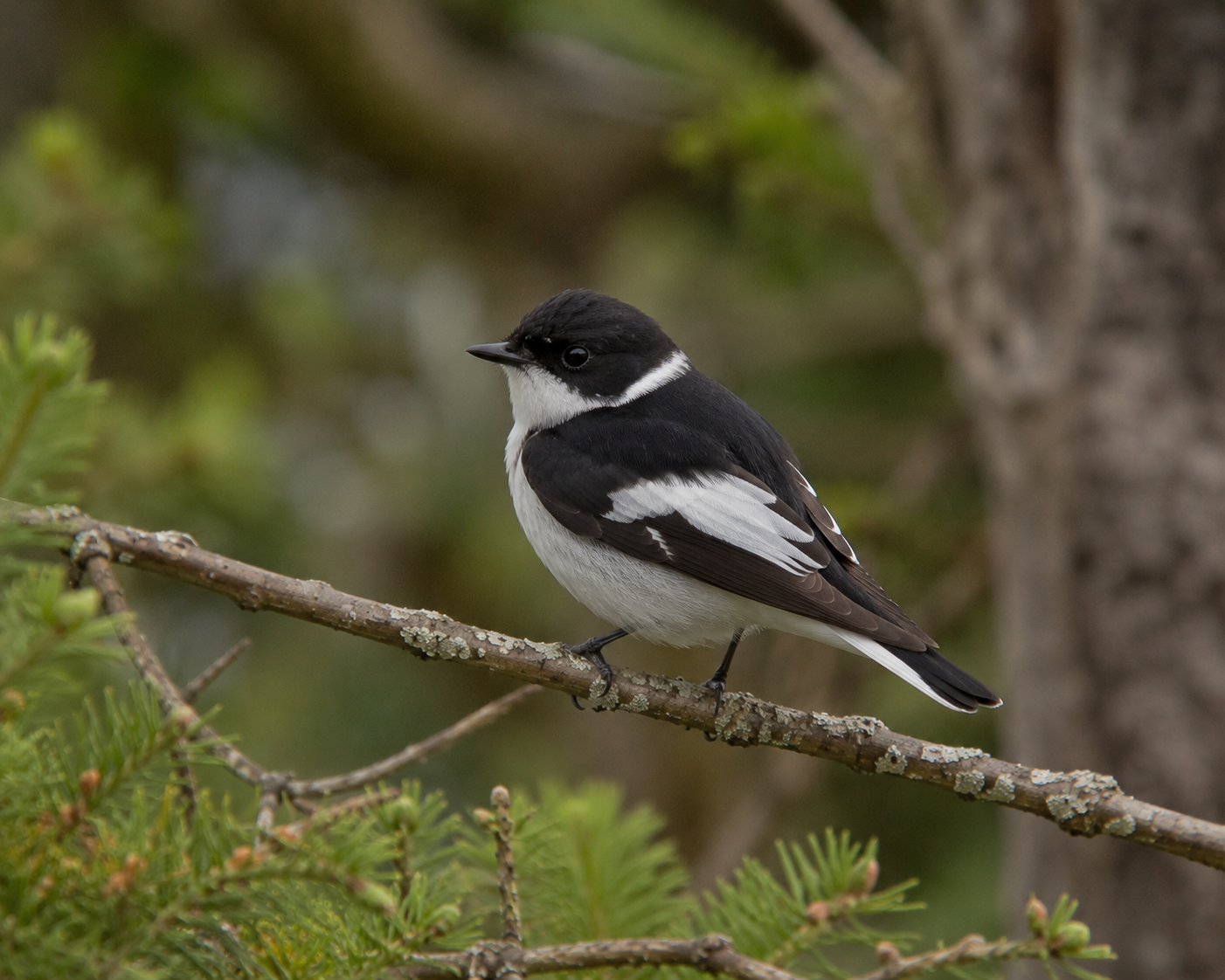
Striking black-and-white European flycatcher of mature oak woodland - the male's bold white collar and broad white forehead separate him from his cousin the Pied Flycatcher. A long-distance migrant from Africa that famously favours nest boxes and is the workhorse study species of European behavioural ecology.
Widespread and abundant; no known immediate threats to the population.
Look-alike rival of the Pied Flycatcher. Males of the two species are nearly identical at a glance - same black-and-white pattern, same shape, same behaviour - but a male Collared has a complete white collar wrapping all the way around the back of the neck, plus a bigger white forehead patch and a larger white wing flash. Females are essentially indistinguishable in the field.
The most-studied songbird in Europe. Long-running nest-box studies in Czechia (since the 1950s) and on Sweden's Gotland (since the 1980s) have produced hundreds of papers on mate choice, hybridisation, immune ecology, and climate-change responses. The species is to European behavioural ecology what Drosophila is to genetics.
A textbook hybrid-zone bird. Where Pied and Collared Flycatcher ranges meet - most famously on Gotland and Öland in Sweden - males of both species sometimes pair with the wrong-species female, producing hybrid young that look like a smudgy mix of the two. The hybrids are usually less fit than pure birds, and the zone has barely shifted in decades.
A long-distance migrant with one of the longer flycatcher journeys in Europe. Collared Flycatchers winter in sub-Saharan Africa - mostly south of the equator, in central and southern Africa - and return north in late April, with the bulk of arrivals in early May. Boxes need to be in place by mid-April or you miss the prospecting window.
They prefer dark, leafy boxes. Field studies repeatedly show Collared Flycatchers pick shaded boxes under leaf cover over identical boxes mounted in the open. The species' natural cavity is an old woodpecker hole in dense canopy - boxes that mimic that low-light environment get occupied first.
Collared Flycatchers will adopt nest boxes enthusiastically wherever mature broadleaf woodland still exists. The trick is timing and placement - the box has to be up by April, mounted under leaf cover, and the surrounding wood needs to be old enough to have natural cavities nearby (the bird benchmarks 'cavity-rich habitat' before settling).
Insectivorous - sallying for flying insects from a perch. They don't visit feeders. Encourage them indirectly by leaving leaf litter, allowing wildflower margins, and avoiding insecticides in nearby gardens.
A 28 mm-hole box, 2–4 m up on a mature oak or hornbeam trunk, under dense leaf cover. Shaded sites are markedly preferred - boxes in full sun are often skipped. Mount with the entrance facing east or south-east away from prevailing wet weather.
Mature, closed-canopy deciduous woodland with standing deadwood. Even a small grove can hold a pair if it's old enough to have natural cavities scattered through it. Open or recently thinned forest doesn't work.
The 28 mm hole admits both Pied and Collared Flycatcher, plus Blue Tit, Marsh Tit, and Coal Tit. Tits start prospecting in February; Flycatchers arrive in May and often evict tits from the box. Multiple boxes per ha (spaced 30 m+ apart) reduces conflict and lets both groups breed.
Get boxes up in March or early April. They arrive from Africa in late April / early May; any box installed after mid-April risks missing the prospecting window for that year.
Don't mount in full sun - the dark, dense-canopy box bias is one of the most consistent results in the literature. Don't clean boxes during the breeding season (May–July); they sometimes re-use the same box the following year and will tolerate old nest material.
Central- and eastern-European broadleaf specialist that winters in sub-Saharan Africa. Breeds in mature deciduous woodland from Sweden's Baltic islands south through Germany, Czechia, Hungary, the Balkans, and east into European Russia.
Densest populations in the broadleaf forests of Czechia, Slovakia, Hungary, southern Poland, and northern Balkans. Common in mature oak and hornbeam stands; reliably occupies nest boxes in those habitats.
An isolated northern population on Gotland and Öland, plus a few mainland Swedish pockets. Hybridises with Pied Flycatcher in the contact zone - the Gotland/Öland populations are the textbook system for studying species reinforcement and reproductive isolation in birds.
Resident-breeder in oak-hornbeam and beech woodland from the Baltic states across Belarus, Ukraine, and European Russia. Always tied to mature broadleaf cover; absent from the boreal conifer belt.
Non-breeding range from the equatorial belt south to Zambia, Zimbabwe, and northern South Africa. Migrants travel 6,000+ km each way; turnover from Europe to wintering grounds takes about 4 weeks.
Mature deciduous woodland with closed canopy and a high density of natural cavities. Oak, hornbeam, beech, and lime are the typical species. Tolerates older parks and well-treed cemeteries; avoids pure conifer plantations and treeless habitat entirely.
Body sized to 4"×4" floor. The 1⅛" panel locks out larger nest competitors while letting the Collared Flycatcher pass cleanly.
Winters in sub-Saharan Africa, mainly south of the equator. One of the most-studied songbirds in evolutionary biology - long-term box studies have produced hundreds of papers on mate choice, hybridisation, and climate-change effects.