Small body + 1⅛" panel
Body sized to 4"×4" floor. The 1⅛" panel locks out larger nest competitors while letting the Coal Tit pass cleanly.
Back to Birdhouse Guide
Periparus ater
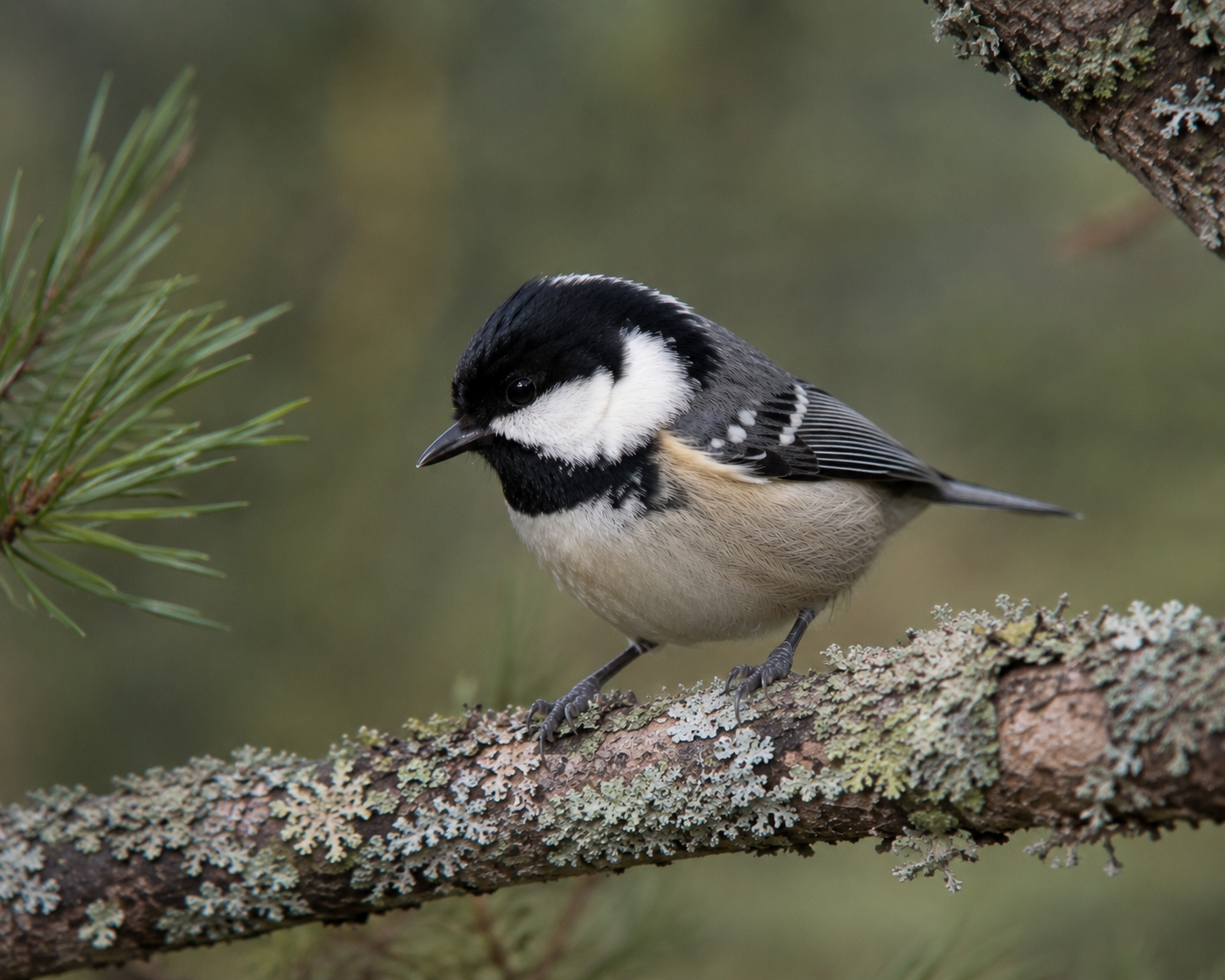
Eurasia's smallest tit - a tiny conifer specialist with a black cap, white cheeks, and a diagnostic white stripe running down the back of the neck. Weighs about as much as a US penny.
Widespread and abundant; no known immediate threats to the population.
Smallest tit in Eurasia - weighs only 8–10 g, about the same as a US penny.
Caches seeds and insects obsessively in autumn, hiding food in bark crevices, moss, and lichen. A single bird can stash several thousand items and remember the locations through winter.
Specialised conifer feeder, with a needle-thin bill tuned for picking seeds out of spruce and pine cones. In mixed flocks they work the highest, thinnest branches that no other tit can reach.
Has a diagnostic white nape patch - a vertical white stripe running down the back of the head, visible even from below. No other Eurasian tit has this marking.
Coal Tits are easy garden visitors anywhere their preferred conifer habitat is nearby. They'll come to standard feeders and adopt small nest boxes readily.
Sunflower hearts, peanut granules, suet pellets, and mealworms. They prefer to grab a single seed and fly off to cache it rather than perch and eat at the feeder.
Mount a 25 mm-hole nest box 1.5–4 m up on a tree trunk or wall, ideally sheltered by a nearby conifer. Coal Tits prefer boxes set well into mature trees rather than open-fronted suburban gardens.
A mature spruce, fir, or pine within 10 m of the box makes a huge difference. They use conifers for foraging, caching, roosting, and predator escape.
A strict 25 mm hole excludes Great Tit and House Sparrow. They'll also lose to Blue Tit when both want the same box, so put up multiple boxes if your garden already has Blue Tits.
A shallow bird bath under cover of the conifer canopy. They visit briefly to drink and bathe but are warier than Blue Tits.
Don't fell or 'tidy' mature conifers. Conifer canopy is the habitat - without it, Coal Tits drop out of a garden entirely.
A widespread Palearctic conifer specialist, resident from Ireland to Japan. Found wherever there's mature spruce, fir, or pine forest, plus mature parks and gardens with conifers.
Common year-round in coniferous and mixed woodland from Scotland and Ireland south through France, the Low Countries, and Iberia. Quietly numerous in mature gardens with old conifers.
Resident across Scandinavia and the boreal forest belt; one of the typical 'spruce-canopy' species. Often the dominant tit in pure conifer plantations where Blue and Great Tit are scarce.
Resident in the conifer zones of the Alps, Pyrenees, Apennines, Balkans, and Atlas Mountains. Descends to lower elevations in winter.
Resident through Russia, northern China, the Koreas, and Japan, mostly in upland conifer forest. The Japanese subspecies (P. a. insperatus) has a distinct buffy belly.
Strongly tied to conifers - spruce and fir especially. Will use mixed deciduous-conifer woodland and mature gardens, but avoids pure broadleaf forest and treeless habitats.
Body sized to 4"×4" floor. The 1⅛" panel locks out larger nest competitors while letting the Coal Tit pass cleanly.
Caches seeds and insects in bark crevices through autumn; remembers thousands of cache sites across winter.