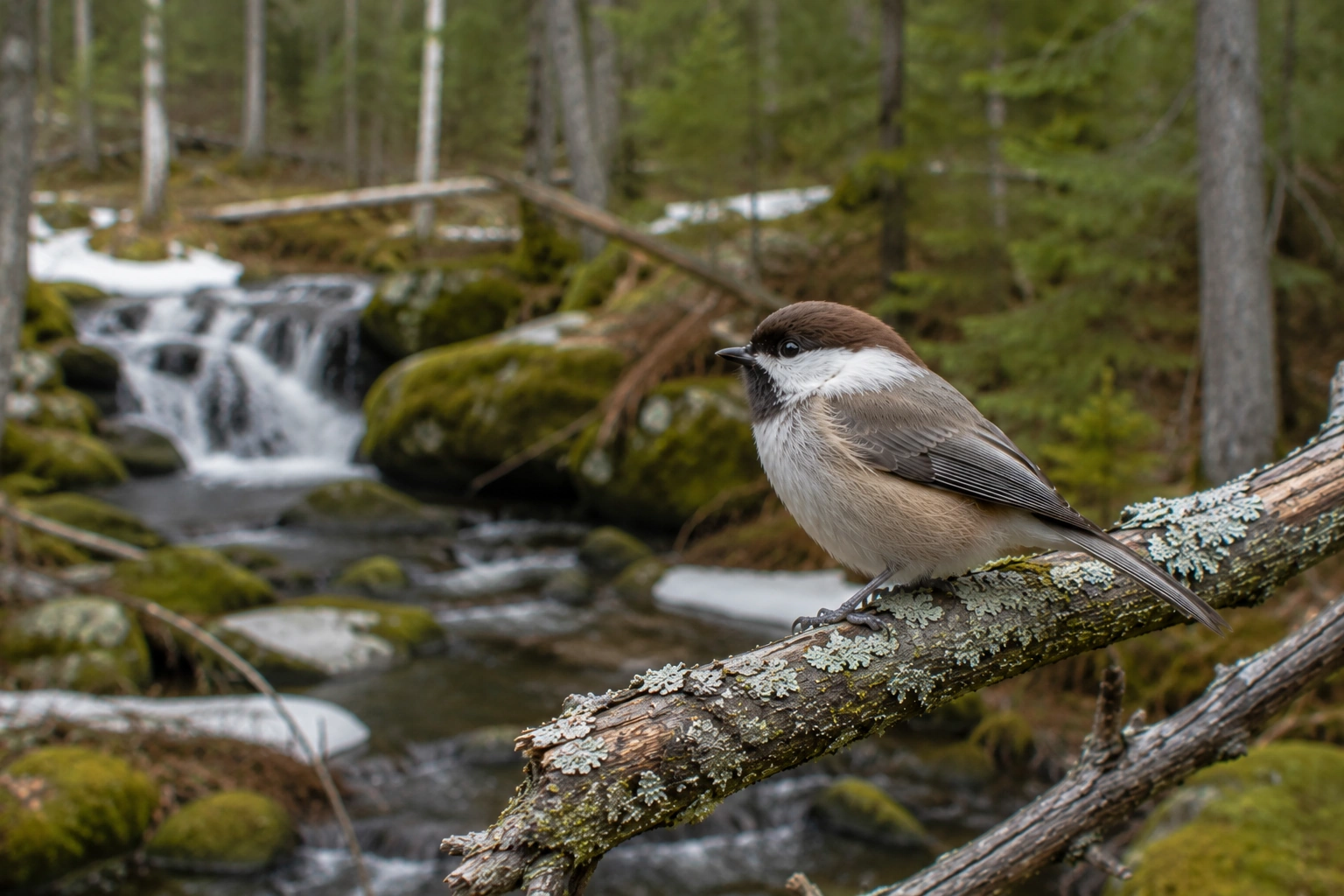
Small body + 1⅛" panel
Body sized to 4"×4" floor. The 1⅛" panel locks out larger nest competitors while letting the Boreal Chickadee pass cleanly.
Back to Birdhouse Guide
Poecile hudsonicus
Brown-capped chickadee of the high boreal forest, far less familiar to backyard birders than the black-capped variety. Survives some of the coldest winter nights of any songbird on the continent.
Widespread and abundant; no known immediate threats to the population.
Caches massive food stores for winter. A single Boreal Chickadee may stash tens of thousands of seeds and insect pupae each autumn.
Drops its body temperature into controlled nocturnal hypothermia to survive –40°F nights in the boreal forest.
The brown cap (instead of black) and rusty flanks are the key field marks separating it from Black-capped Chickadee.
Often the only songbird remaining in deep boreal spruce forests in mid-winter.
Resident across the entire North American boreal-forest zone from Alaska to Newfoundland, with the southern edge reaching the northernmost contiguous US states.
Year-round through Yukon, NWT, all the prairie provinces, Ontario, Quebec, Labrador, and Newfoundland.
Breeds in northern Minnesota, Wisconsin, Michigan's Upper Peninsula, northern New York, Vermont, New Hampshire, and Maine.
Resident across the interior and southern parts of the state.
Body sized to 4"×4" floor. The 1⅛" panel locks out larger nest competitors while letting the Boreal Chickadee pass cleanly.
Stores enormous food caches to survive –40°F winter nights.