Small body + 1⅛" panel
Body sized to 4"×4" floor. The 1⅛" panel locks out larger nest competitors while letting the Bewick's Wren pass cleanly.
Back to Birdhouse Guide
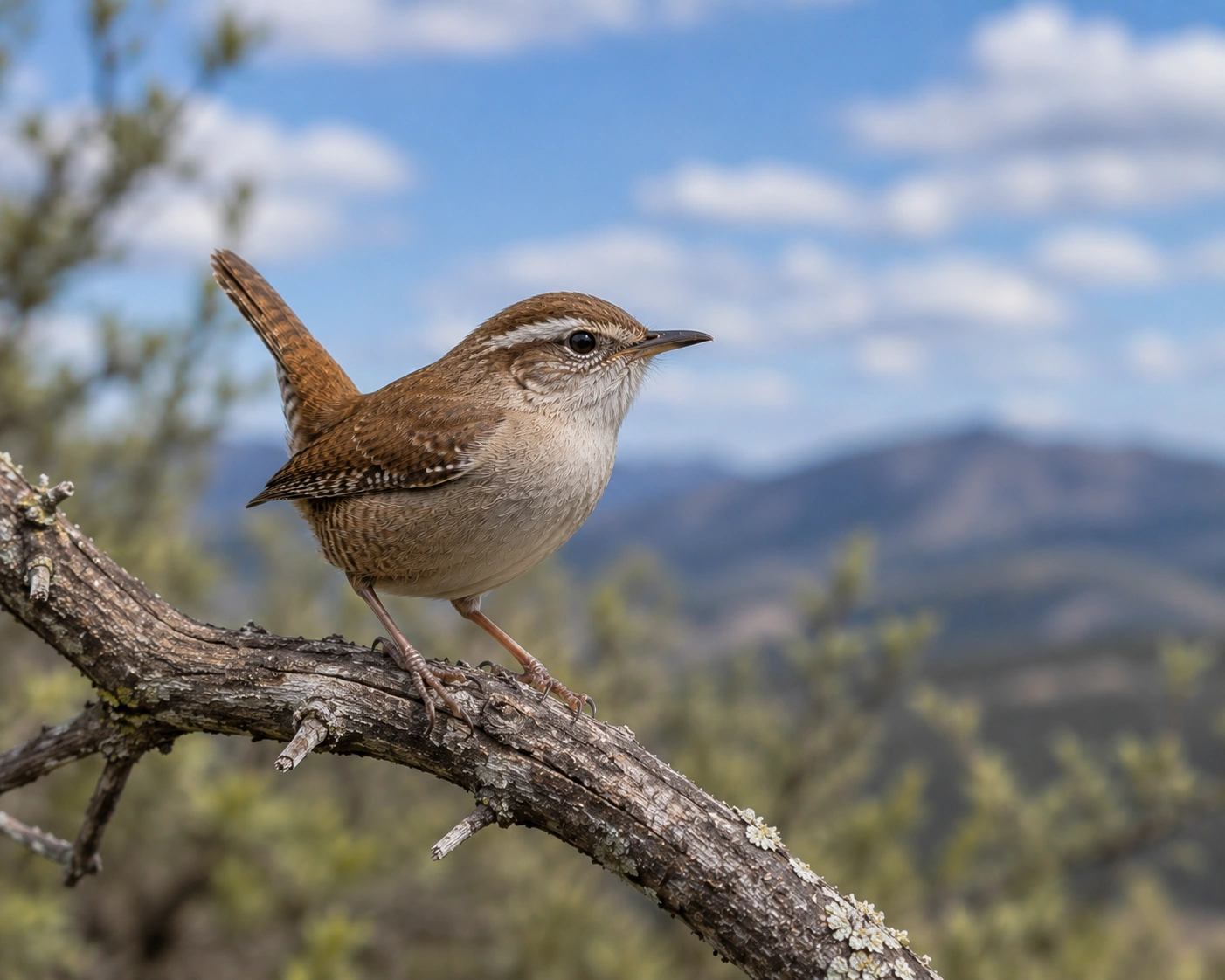
Thryomanes bewickii
Slim, long-tailed western wren with a bold white eyebrow and a complex, musical song that males learn from their neighbors. Once common across the eastern US, now mostly a bird of the western half of the country.
Widespread and abundant; no known immediate threats to the population.
Bewick's Wrens are the West's answer to the Carolina Wren, but they've been almost entirely displaced east of the Mississippi, likely by competition from House Wrens.
Males learn their songs from neighbors, not their fathers. A single male may carry 9–22 distinct song types in his repertoire.
They poke their long tail straight up over their back when foraging. A Bewick's signature you can spot from across the yard.
Bewick's Wrens love thickets and tangle. Plant for cover, leave brush, and they'll often use a small nest box in the same spot every year.
Plant or preserve dense native shrubs, manzanita, coyote brush, blackberry brambles, or sumac. The thicker the better.
Mount the box 5–8 ft up in a quiet corner of the yard near brushy cover. They'll also use a hanging gourd or a sheltered porch shelf.
Like House Wrens. They're insect specialists. No feeders needed. Garden for native insects with a no-pesticide yard.
A small low birdbath or even a saucer of water tucked under a shrub. They like seclusion when bathing.
Don't site the box near House Wren territory if you can help it, Bewick's Wrens are routinely displaced by their more aggressive cousin.
Once widespread across the eastern US, now mostly a western species, common from the Pacific Coast through the Rockies and into Texas.
Year-round residents from Washington south through California, Arizona, and into northern Mexico. Common in chaparral, oak woodland, and suburban yards.
Common throughout central and western Texas, Oklahoma, and into eastern New Mexico. Year-round residents.
Once common from the Appalachians to Iowa; now rare and locally extinct across most of this range. The few remaining Eastern populations are protected.
Resident throughout central and northern Mexico, from Sonora and Chihuahua south to Oaxaca.
Shrubby, semi-open habitats: chaparral, oak woodland, riparian thickets, suburban gardens with plenty of dense cover. They love stick piles and hedge corners.
Body sized to 4"×4" floor. The 1⅛" panel locks out larger nest competitors while letting the Bewick's Wren pass cleanly.
Year-round resident in much of its range; a clean dry box doubles as a winter shelter.