 Back to Birdhouse Guide
Cavity Nester
American Kestrel
Falco sparverius
Back to Birdhouse Guide
Falco sparverius
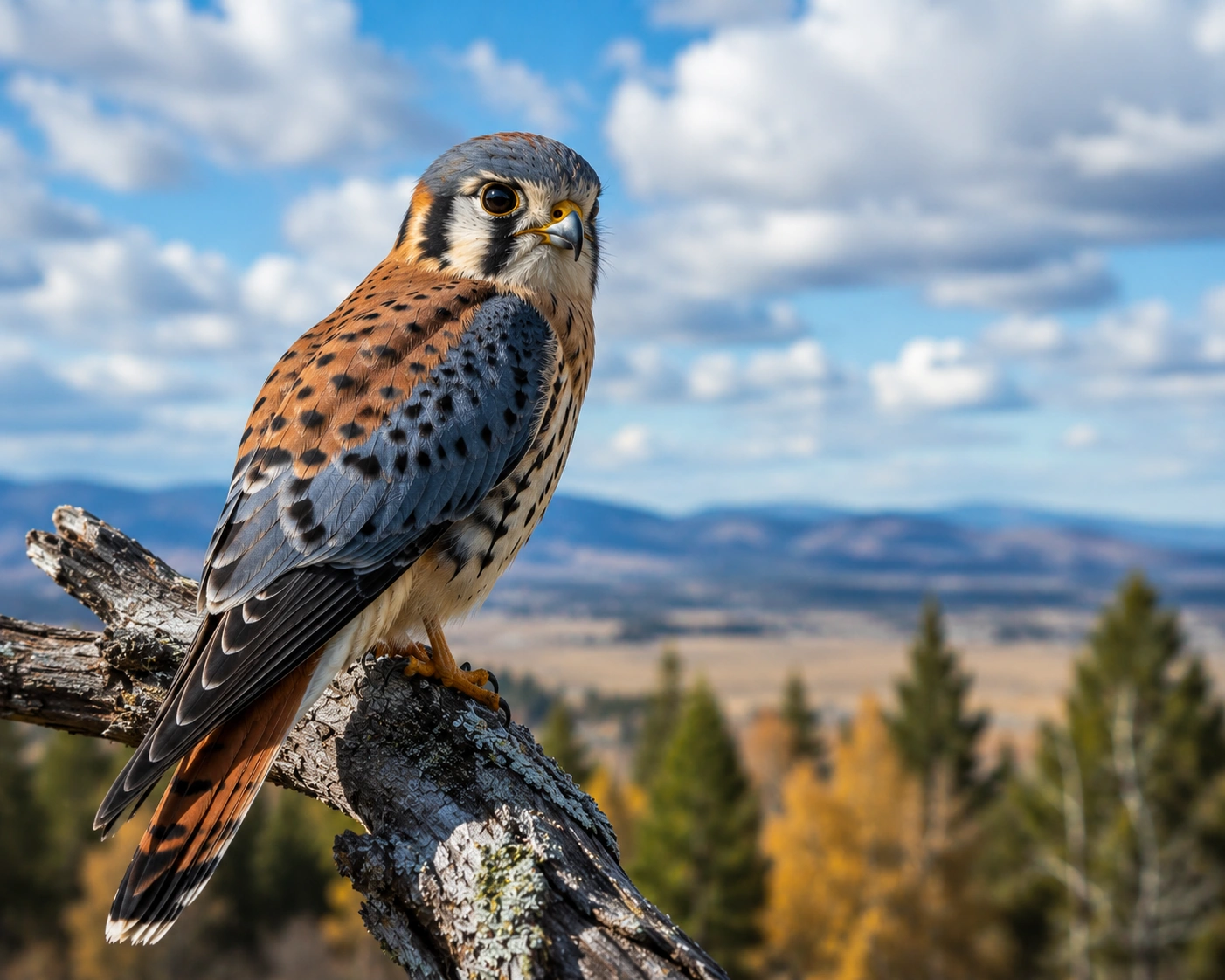
A robin-sized falcon and the most colorful raptor in North America, with rust, slate-blue, and bold black markings. Hovers on rapid wingbeats while scanning for grasshoppers and voles.
Widespread and abundant; no known immediate threats to the population.
American Kestrels are the smallest falcon in North America, a 4-ounce raptor that hunts grasshoppers and small rodents.
They have UV-sensitive vision and can detect rodent urine trails from the air, a major hunting advantage.
Populations have declined sharply over the last 30 years; nest box programs are part of an ongoing recovery effort.
Kestrels need open hunting ground and a tall nest site. A properly-built kestrel box on a pole in a pasture can attract a pair.
Mount a kestrel-sized box 10–20 ft up on a pole, large tree, or barn wall in fully open habitat.
OPEN ground, pasture, farm field, or large lawn, within sight of the box. They hover-hunt, so they need clear airspace.
Insects, small rodents, and lizards from the surrounding habitat. No feeders work.
European Starlings often dominate kestrel boxes, site in true open country, away from urban edges.
Don't site near dense trees; kestrels need open hunting visibility.
A widespread small falcon found across most of North and South America, from Alaska to Tierra del Fuego.
Year-round in middle latitudes; northern birds migrate south.
Common breeder across the southern half of every province.
Resident throughout, including the Caribbean.
Open and semi-open country: pastures, grasslands, deserts, agricultural land, golf courses, and roadside corridors with perches and mowed ground.
This species needs a box larger or differently-shaped than our three standard sizes. We make these as one-off prints to the published nest dimensions, with all the species-specific requirements baked in.
North America's smallest falcon, open habitat (farms, grasslands). Add 2" wood shavings; predator guard mandatory.